
What is a rug publisher?
Between an artist's drawing and the rug laid on the floor, there is a craft: publishing. What the house of Diacasan does, with which workshops, and what it changes for whoever chooses a piece.
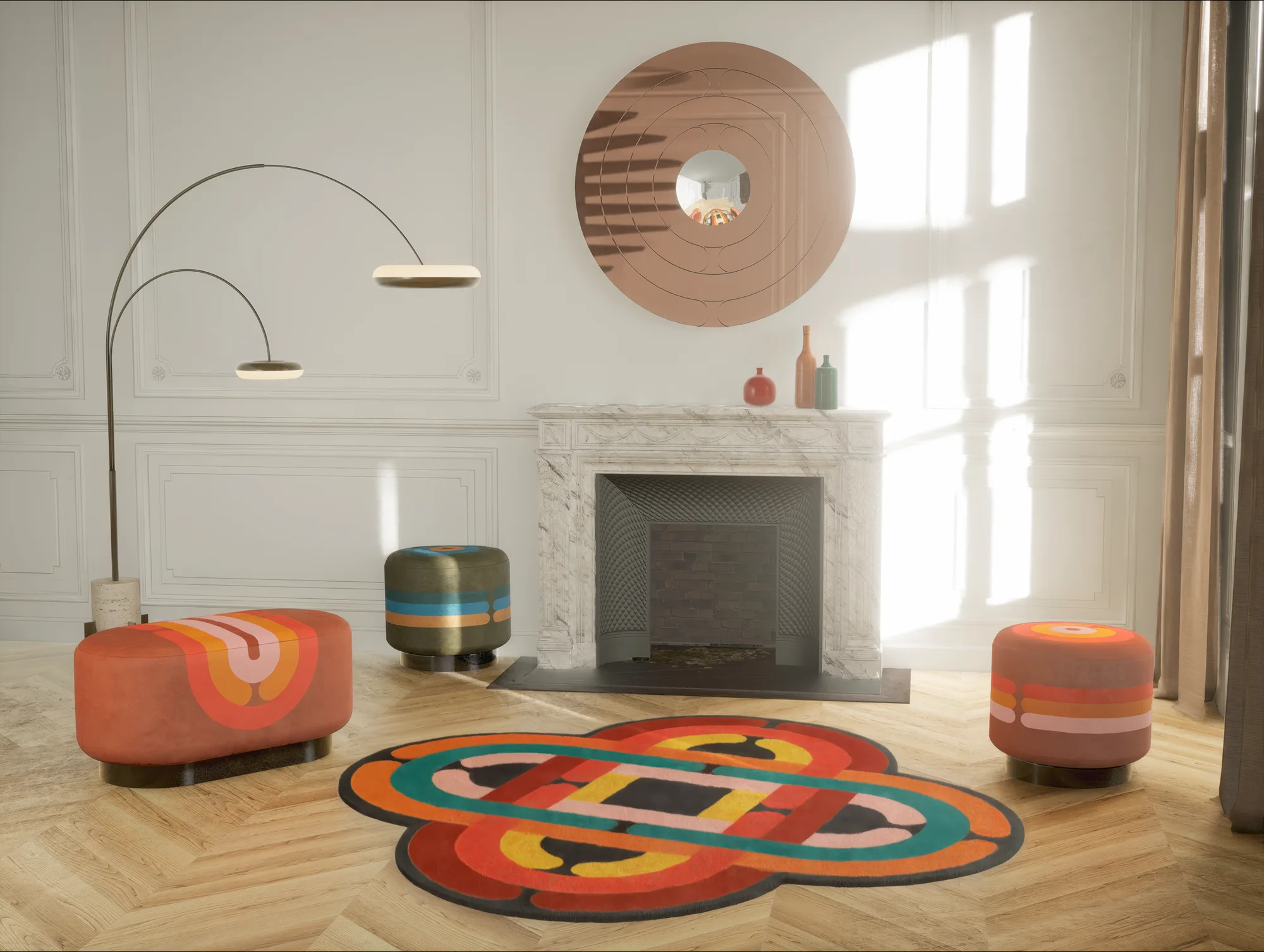
A rug publisher neither draws rugs nor knots them. He chooses an artist, a material and a workshop, has them work together until the piece is right, then signs it, makes it in small series and brings it to the world: at the showroom, to architects and decorators, at trade fairs. It has been the craft of Diacasan Edition since 2000. Sandrine Demas sums it up in three verbs: a publishing house creates, makes and distributes. A published contemporary rug thus carries a double signature, that of the artist and that of the house, and a legible provenance: a drawing, a technique, a country of making, a workshop with which the house has long worked. For the one who buys it, it is the most direct way of knowing what lies underfoot, who conceived it and who made it.
What does the house do between the artist and the workshop?
It brings two crafts that do not speak the same language to understand each other. The artist creates in his own medium: engraving, painting, photography, flat drawing. The workshop knows what wool accepts, what a knot or a tuft can render, how much time it takes. Between the two, someone must decide.
The artistic director of Diacasan calls this work “setting it to music”. She directs the piece: which pile, which pile height, which palette of dyed wools, which workshop for which drawing. “I am neither an artist nor a designer, but I love working alongside them,” she says. The phrase describes exactly the place of the publisher.
The collections of the house bear the trace of it. The first project with Christian Signorel was MINOTOR, a dense, richly worked drawing, difficult to translate into tufting: the workshop in India took several weeks to find the stitch that renders both the strength of the line and the softness of the rug. For SUR LE FIL, the first engraving by Renaud Allirand required a complete recomposition before it could be knotted. For PAINTINGS, the artisans learned to modulate the tufting in order to render the touch of Jean-Paul Espinosa, and each piece raised the same question: what to keep from the canvas, what to reinvent in the textile? These decisions belong neither entirely to art nor entirely to technique. They belong to publishing.
Why speak of artists' rugs?
Because each collection is born of a work and of an artist's eye. The artist's rug is an artistic gesture that changes scale and material, with the agreement of the one who created it.
At Diacasan, the artist always comes first. Christian Signorel draws lines, curves and geometric structures; his collections MINOTOR, BESTIAIRE and LUKAN are its successive chapters, and MINOTOR 2.0 adds relief to them. Renaud Allirand, painter and engraver, has seen his small-format engravings become rugs hand-knotted in Nepal, in wool, hemp and silk. Jean-Paul Espinosa makes colour vibrate in PAINTINGS, hand-tufted in India. Emmanuel Thibault, photographer, left the figure for texture with SPATIAL, hand-knotted in Nepal. Studio Messieurs imagined GRAND NORD, where the rug and the armchair were conceived together. Sophie Tolachides, photographer and geographer, signs VUE DU CIEL. And the NEPALESE RUGS collection makes craftsmanship itself the motif.
What unites these very different signatures is a shared standard for material and a way of working that recurs from one piece to the next. The story of this lineage, from the Oriental rug to today's artists, is the subject of a separate article: from the Oriental rug to the artist's rug. The method that allows an engraving or a canvas to become a floor is told in what the drawing does not say, and the collection of Jean-Paul Espinosa in when painting comes down to the floor.
Choosing a technique is already publishing
The same work will not yield the same rug depending on whether it is knotted or tufted, and this choice belongs to the publisher. It depends on the drawing, the desired material, the format and the time available.
Hand-knotting is the essence of the Oriental rug: each point is knotted by hand, one by one. For a large format, allow four to six months of work. The piece gains suppleness, depth, and acquires a patina over the years, like a fine piece of furniture. The house does it in Nepal, with hand-spun Himalayan wool, whose natural irregularity is sought after. Hand-tufting is another craft, quicker, which allows broader collections and shorter lead times; it is carried out in India, often in very pure New Zealand wool, essential for clean whites and ecrus. The two gestures are of equal worth. They serve different drawings.
Publishing also means setting aside. The house did a little knotting in India then stopped, because the essence of knotting, in its eyes, lies in Nepal; a knotted-woven technique is now in development in India with Christian Signorel. It set China aside, where the wool seemed too soft for the craftsmanship it seeks. The differences between the two gestures are detailed in hand-knotted, hand-tufted, and those between the two wools in Himalayan wool, New Zealand wool. The craftsmanship page brings it all together.
Workshops chosen twenty-five years ago
A publisher is only worth the workshops with which he works, and the house has worked with the same ones for twenty-five years. The first stay in India dates from November 2000; the counterpart met then for hand-tufting is still the house's counterpart today. In Nepal, the historic partner knots the rugs of SUR LE FIL, SPATIAL and NEPALESE RUGS. The founder recognised this workshop in a courtyard, among folded rugs, finding the ones she had been looking for without believing she would find them.
This duration changes the quality of the dialogue. A workshop that knows the house understands a request before it is fully formulated, knows what it will refuse, and can commit to a difficult drawing. In Italy and France, workshops of human scale make the furniture and the soft furnishings: the armchairs and poufs of GRAND NORD, the cushions, the Mircur mirrors of MINOTOR, made in Italy. The relationship with Nepal is told in Nepal, the Oriental rug of today.
The rue du Bac showroom, in Paris, is its window. It was redone in 2023, for the twenty-fifth anniversary of the house, in a scenography by Messieurs: limestone arches, niches that give each rug its own light, and an oval MINOTOR Cuivre at the back. The rue du Bac scenography features among the house's realisations.
Publisher, manufacturer, white label: where does the line fall?
The line falls at the name inscribed on the piece and at whoever takes responsibility for the choices. A manufacturer makes what he is asked to make. A publisher decides what will be made, with whom, and answers for it.
Diacasan has known the other side. During its first decade, the house made white-label rugs for a major Italian furniture house, that is, pieces sold under someone else's name. For the publisher, the distinction is clear: “That is white label, it is not publishing, I am not the publisher, he is the publisher.” The experience taught a great deal about the rigour of a great publishing house. It also confirmed what Diacasan wanted to be.
The project is something else again. For an interior architect or a decorator, the house conceives a piece for a specific place, from the collections or a dedicated drawing, with its workshops. What these specifiers seek, in the words of the house, are “pieces with a story that can be told to the end client”: an artist, a technique, a workshop, a lasting relationship. The approach is detailed in the rug in an interior architecture project and on the Studio page.
What publishing changes for the buyer
It gives a provenance and a coherence. Each record says who created the piece, how it is made, where, and with what material: the resemblance between the records is intended, because each one may be the first to be read.
It also gives a style. “Style is important, that is a key word,” says Sandrine. The word designates a line the house holds from one collection to the next, and which means a Diacasan piece is recognised in an interior.
It explains, finally, time and price. The house does not work in large series: it keeps stock of the most requested pieces and makes the rest to order. The price of a hand-knotted rug is a consequence of time, material and gesture, never an argument; it is the subject of the article the price of a hand-knotted rug, and what it pays for. To judge a piece for oneself, recognising a handmade rug gives the essential markers, and a rug acquires a patina tells what wools become over the years.
Reading the journal of the house
This journal follows the same logic as the catalogue: each article starts from a real question and answers it with what the house knows. For material, the making of a knotted rug, from spinning to finishing details the workshop operations, and relief in a rug explains what MINOTOR 2.0 changed. For use, what size of rug for a living room and caring for a wool rug answer the most frequent questions at the showroom. For colour, the blue of the house, geometry, from MINOTOR to the line and choosing the colour of a rug extend the work of the artists. To see the pieces, the showrooms and the collections remain the best place to begin.
Hand-tufted in India. Hand-knotted in Nepal. Furniture in Italy, soft furnishings in France. From creation to publishing.
Text written by the house of Diacasan Edition from interviews with Sandrine Demas, our collection records and exchanges with our workshops in India and Nepal, October 2026.
Questions fréquentes
What is the difference between a rug publisher and a manufacturer?
The manufacturer makes; the publisher decides what will be made and signs it. A rug publisher chooses the artist, the material, the technique and the workshop, oversees the development of the samples, then distributes the pieces under his name. At Diacasan, making is entrusted to partner workshops in India and Nepal, with which the house has worked for twenty-five years, and the furniture to workshops in Italy and France. The house answers for each piece, from drawing to finishing.
What is an artist's rug?
It is a rug whose design comes from an artist and which has been translated into wool with his agreement, by a publisher and a workshop. At Diacasan, examples include the engravings of Renaud Allirand knotted in Nepal in SUR LE FIL, the canvases of Jean-Paul Espinosa tufted in India in PAINTINGS, or the geometries of Christian Signorel in MINOTOR. The rug bears the signature of the artist and that of the house, and its record states the technique, the material and the country of making.
What is a high-end contemporary rug?
It is first a question of material, gesture and provenance, before being a question of price. A wool chosen for its resilience, knotting or tufting done by hand, careful finishing and an identified workshop make the difference with a mass-produced rug. At Diacasan, each piece is published in small series, with an artist's drawing and artisanal making in Nepal or India. The article on the price of a hand-knotted rug details what this working time represents.
Is a published rug a unique piece?
A published rug is made in small series, in the formats and colourways defined for the collection. The house keeps stock of the most requested pieces and makes the others to order, which explains the lead times indicated on each record. For a specific place, an architect or a decorator can also undertake a project with the house: the piece is then conceived for that space, with the workshops that make the collections.
Where can Diacasan rugs be seen in Paris?
At the rue du Bac showroom, in the seventh arrondissement, redone in 2023 in a scenography by studio Messieurs. The rugs are shown there in niches that give each its own light, which allows colours and reliefs to be judged better than on a screen. Addresses and visiting arrangements are on the showrooms page of the website. Touching a rug remains the best way to understand it.