
What the drawing does not say
Entrusted to other workshops, the same drawing would yield other rugs. Technique, fibre, scale, wool colours: what the publisher decides between the artist's sheet and the finished piece.
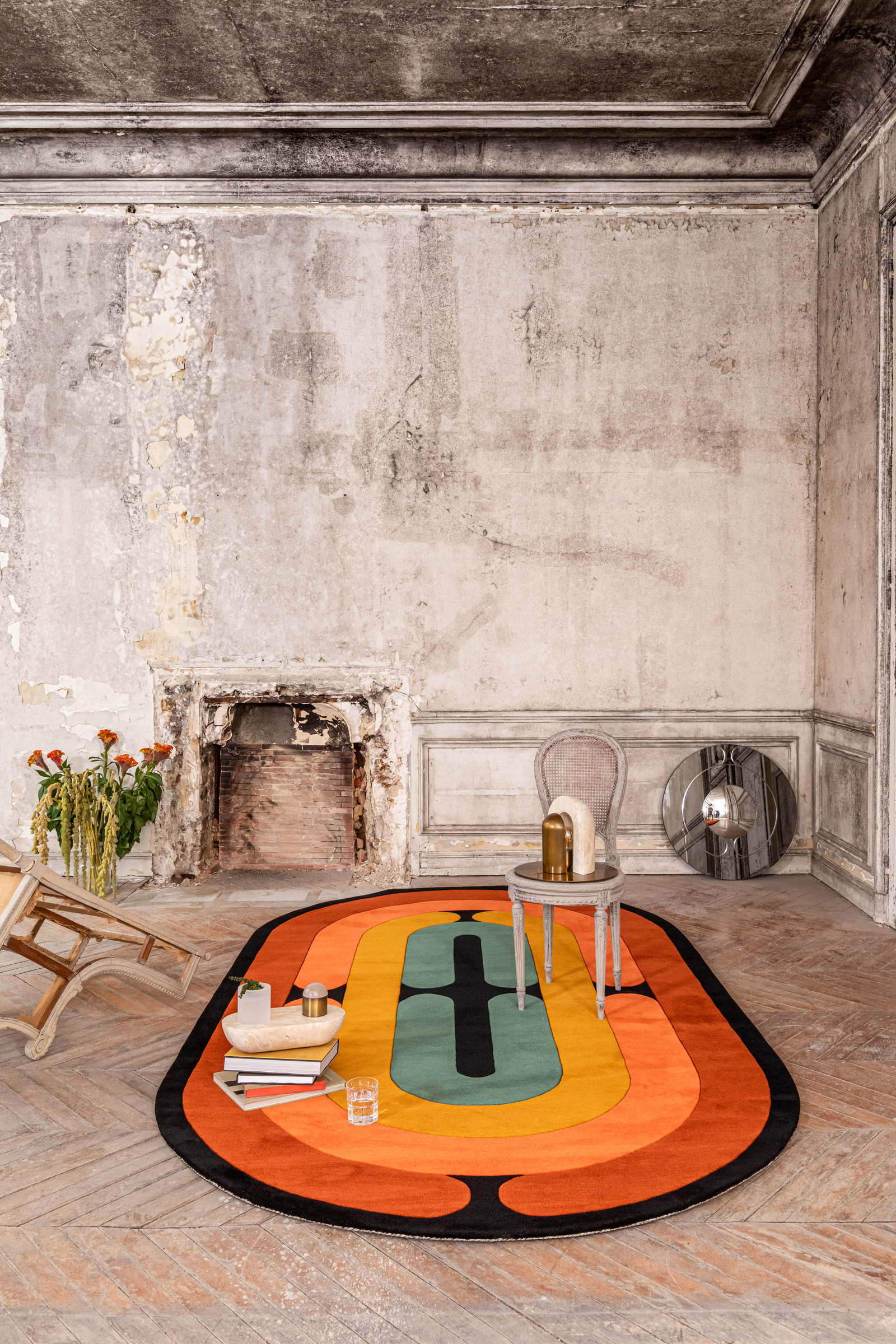
The same drawing, entrusted to two workshops, does not yield the same rug. It is the first thing one learns in publishing artists, and it is the reason why a drawing, however precise, remains incomplete. It fixes an image. It fixes neither the technique, nor the fibre, nor the density of the pile, nor the way a painted colour will become a dyed wool, nor what the composition will become once enlarged to the scale of a floor. These decisions fall to the publisher, and at Diacasan Edition they fall to Sandrine Demas, who puts it this way: “there is never just one way to interpret a rug”. Between the artist's sheet and the delivered piece there is therefore an interpretation, in the sense a musician means it: the drawing is a score: it fixes the notes, and the way of playing them belongs to the performer. For an architect or a decorator, understanding this invisible work makes it possible to know what one is buying, and what one can ask for.
The technique is chosen after the drawing
A drawing arrives alone, without its technique. It is for the house to hear it and decide whether it will be hand-knotted in Nepal or hand-tufted in India. Some drawings lend themselves to both, and the choice then depends on what one wishes to obtain, the price in view, the place where the piece will be shown. Others impose one.
The paintings of Jean-Paul Espinosa were tried in knotting in Nepal. The result did not suit these creations, and the PAINTINGS collection is hand-tufted in India, as we recount in the story of these painter's rugs. Conversely, the compositions of Emmanuel Thibault for SPATIAL are so detailed that only knotting holds: the Nepal workshop uses its finest knotting, and must even weave across the grain to render their details. The engravings of Renaud Allirand could be tufted. The house presents them hand-knotted, because that is how the drawing best carries its line.
The material changes the touch
Two hand-tufted rugs, on the same drawing, can read very differently depending on the fibre. We experienced this with Jean-Paul Espinosa. In wool, the production left a slight staccato in the pile, which did not suit the fluidity of his painting. The artist did not like it, and he was right. Tencel restored the continuity of the gesture. The pieces remain possible in wool for clients who ask for it, but the reference interpretation, the one the artist recognises, is in Tencel.
Sometimes the material even precedes the drawing. GRAND NORD began with a sample of tousled wool found in a workshop, and only afterwards did studio Messieurs draw the polar bear it evoked. The founder sums it up in a word: there, we took it the other way round. In every case, the question is the same: which fibre will serve what the artist meant to say?
Scale is verified in prototype
A drawing is looked at flat, at the distance of a table. A rug is looked at standing, a few steps away, under a changing light. Between the two, everything can tip. A nervous line can become confused, a detail disappear, a colour take up too much room.
Renaud Allirand engraves on small paper formats. Moving from the plate to the rug required, for the first piece, far more than an adaptation: a complete recomposition. The first MINOTOR by Christian Signorel, dense and richly worked, required several weeks at the workshop in India before the right stitch was found, the one that keeps the power of the drawing and the softness of the rug. For MINOTOR 2.0, we had prototypes made at different scales, and each colourway was tried in both directions, before keeping the Oblong and Nef formats.
These trials commit the decision. We make samples, we look at them, and if the piece does not convince, the publisher does not launch it. The artist can be right on paper and the rug prove him wrong. The reverse happens too.
Colour is composed in the workshop
A painting passes from one shade to another without a break. A tufted rug is built in zones, which the artisan executes one after another. These zones must therefore be determined within the image, and that is a skill in itself: our counterpart in India knows the rugs of Jean-Paul Espinosa so well that he can isolate the zones of a canvas. For the shades, the artistic director chooses with the artist pompoms of dyed wool, which go to the workshop with the image.
Colour is also decided at the scale of a collection. The model of an engraving by Renaud Allirand was red: the artist wanted the piece in red, and we made it. The first series was then conceived on primary colours, before the palette softened more recently. Each rug is a decision; a collection is a set of decisions that must hold together. This is what Sandrine calls setting it to music.
What a specifier can expect from it
For an architect or a decorator, this work has two consequences. The first is a guarantee: a rug published by the house is an interpretation developed with the artist and a workshop we have known for twenty-five years. That is also why copying worries her little: from one workshop to another, the same drawing does not come out the same, because everything depends on the development.
The second is a lead time. A project often begins with a sample, which allows the client to judge the material, the colour and the relief before ordering. This sample sometimes precedes the order by several months, occasionally more. That time is part of the piece. It also gives the specifier what he is looking for, pieces with a story that can be told to the end client: an artist, a technique, a workshop, a lasting relationship. We develop this point in our article on the rug in an interior architecture project, and the craftsmanship of our workshops is presented on its own page.
The artist's drawing remains the source and the reference for every decision. The rest is the craft of a rug publisher. First the sample. Only then, production.
Text written by the house of Diacasan Edition from interviews with its founder and exchanges with our workshops in Nepal and India, October 2026.
Questions fréquentes
How does an artist's drawing become a rug?
Through a series of decisions the drawing does not contain. The house chooses the technique, hand-knotted in Nepal or hand-tufted in India, then the fibre, the division into colour zones and the wool shades, with the artist. The workshop produces a sample or a prototype, which the artist and the house approve or send back for revision. Production only begins once this agreement is reached, and each rug then bears the artist's signature.
Why can the same drawing yield different rugs?
Because everything depends on the development. The technique, the fibre, the density of the pile, the way colours are divided and the hand of the workshop change the result. The same motif tufted in wool or in Tencel does not read the same; a very detailed drawing will not render the same in fine knotting and in tufting. That is why an artist's rug published by a house stands apart from a mere reproduction.
What is the sample for in making a rug?
The sample is the first physical contact between the drawing and the material. It makes it possible to judge the colour, the touch, the relief and the hold of the motif before launching a whole piece. In an interior architecture project, it also serves the end client, who sees and touches the material before ordering. When the sample does not convince, the work resumes: a change of fibre, of stitch or of colour.
Can one choose between hand-knotted and hand-tufted for a drawing?
Sometimes. Some drawings lend themselves to both techniques and the choice is made according to the desired rendering, the budget and the lead time. Others impose one: the very detailed compositions of SPATIAL require very fine hand-knotting in Nepal, while the paintings of PAINTINGS only work hand-tufted in India. A knotted rug acquires a patina and folds; a tufted rug is quicker to make and stiffer. The showroom helps to decide.
How long does it take to go from drawing to rug?
It depends on the technique and the complexity. The development alone can take several weeks, as for the first MINOTOR by Christian Signorel. For a large hand-knotted format, the workshop's work is then counted in months, in the order of four to six. In a project, the time for the sample and its approval must be added. It is best to plan generously and to raise it from the outset.