
A rug acquires a patina
The word belongs to waxed furniture and bronze. It also suits the hand-knotted rug, when its wool is living and well treated: what time gives it, and what turns it grey.
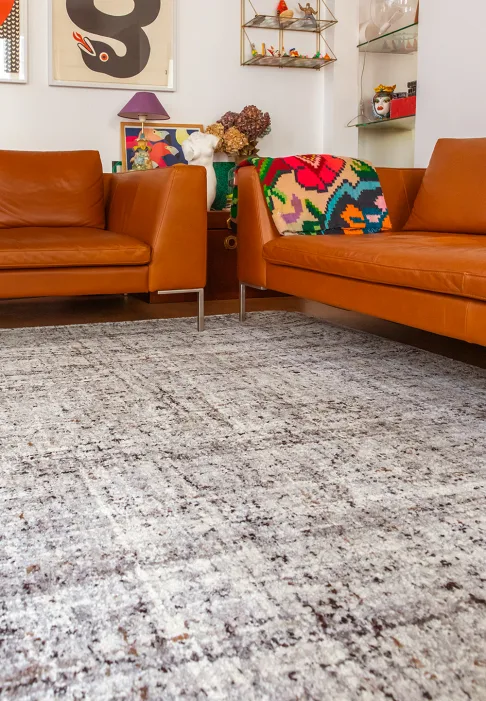
Patina: the word ordinarily belongs to waxed furniture, to bronze, to leather. It also suits the hand-knotted rug. A knotted rug takes on a patina when its material is living and has been well treated: a natural wool, spun by hand, then washed, scraped and stretched at the workshop. Over the years, footsteps soften it, use marks it without damaging it, and the piece gains a presence the new rug did not yet have. It is the opposite of wear. What prevents a rug from acquiring a patina almost always lies in the material: a poor-quality wool, or a dead wool, turns grey instead of ageing. That is why we speak of patina for our knotted rugs from Nepal, in Himalayan wool, and why we go to see this wool at the workshop before having it knotted.
Where does patina come from?
From the wool, first. A wool shorn from a living animal remains a living fibre. Ours is spun by hand in Nepal, and each thread, a little different from its neighbour, takes colour and light in its own way.
From the treatment, next. Once knotted, the rug passes through the water of the tanks, then under the scraper, before being stretched again on a frame. These operations rid the fibre of what encumbered it and stabilise the whole; they also give the rug a resilience that will allow it to cross the years. A knotted rug prepared in this way withstands a great deal. It ages well. We follow these stages one by one in the journey of a knotted rug.
Why do some rugs turn grey?
Because their wool came from a dead animal. This is what the trade calls a dead wool: it can look superb on the day of purchase, then die out a year later. Sandrine remembers a period when rugs from Turkey were made of it, and the unpleasant surprise that followed: “when you buy it, it is all beautiful, then a year later, it is grey”.
At the time of purchase, the difference remained invisible. It appeared once the rug was laid, when it had met the air. That is why material is judged at the workshop, before knotting, and why we detail our wools in Himalayan wool, New Zealand wool.
Living with a rug that changes
A knotted rug is not made to stay as it arrived. It takes the shape of the room and keeps the trace of passage. The Oriental rugs kept from one generation to the next owe much to this long tempo, and the publisher says it in a sentence: “A rug is often a family story.”
It also accompanies house moves. Supple, the knotted rug folds for the journey, then takes its place again underfoot once laid down. A rug that changes house without damage is a rug that can last.
For those who love colour, this is no doubt the finest part of it. Across a flat field of hand-spun wool, the shade already moves with the angle and the hour; the years add to this movement the trace of the life of the room. No new rug can have that surface.
This patina asks for little. Gentle vacuuming, in the direction of the pile, no full sun for months on end, and a professional for stains: our records ask for no more. We will return to this in detail in caring for a wool rug. The rest is done by time.
The pieces of NEPALESE RUGS, hand-knotted in Nepal in Himalayan wool, are conceived for this duration: broad flat fields, timeless drawings, a wool with time before it. Mikado, one of the first drawings of the house, is still published there.
The founder borrows her image from the cabinetmaker: a knotted rug “acquires a patina like a fine piece of furniture”.
Text written by the house of Diacasan Edition from conversations with Sandrine Demas on material, making and the life of knotted rugs, October 2026.
Questions fréquentes
What is the patina of a rug?
It is the way a rug evolves over time when its material is living and well treated. Footsteps soften the pile, use marks the surface without damaging it, and the piece gains a presence it did not have when new. At Diacasan, we use the word for our rugs hand-knotted in Nepal, in Himalayan wool spun by hand, washed and scraped at the workshop. Patina is the opposite of wear: it presupposes a good wool from the start.
Does a tufted rug acquire a patina?
It ages differently. A tufted rug, stiffer, does not go through the washing and scraping that complete a knotted one, and its reverse is glued and canvas-backed. How it holds over time depends mainly on the quality of its wool, the weight of material per square metre and the treatment of the yarn. A well-made tufted rug keeps its frank colours and crisp contours for a long time. The word patina, with us, remains attached to knotting.
Why does a wool rug turn grey?
Most often, because its wool was mediocre or dead, that is, taken from a dead animal. Such a wool can look very beautiful at purchase, then turn greyish after a year, as if the colour were dying out. A living wool, well chosen and well treated, does not react this way. That is why the material is checked at the workshop, before knotting.
How can a knotted rug be helped to age well?
By letting it live, with a few precautions. Vacuum it gently, in the direction of the pile, avoid leaving it long in full sun, and entrust a stain to suitable professional cleaning rather than rubbing. A knotted rug can be washed, but it must then be stretched again, otherwise it would dry wavy. For the rest, time and passage do their work: it is from them that patina comes.