
The rug in an interior architecture project
Hotel, restaurant, apartment: how an interior architect or a decorator undertakes a rug project with the house, from the choice of technique to the story it will tell their client.
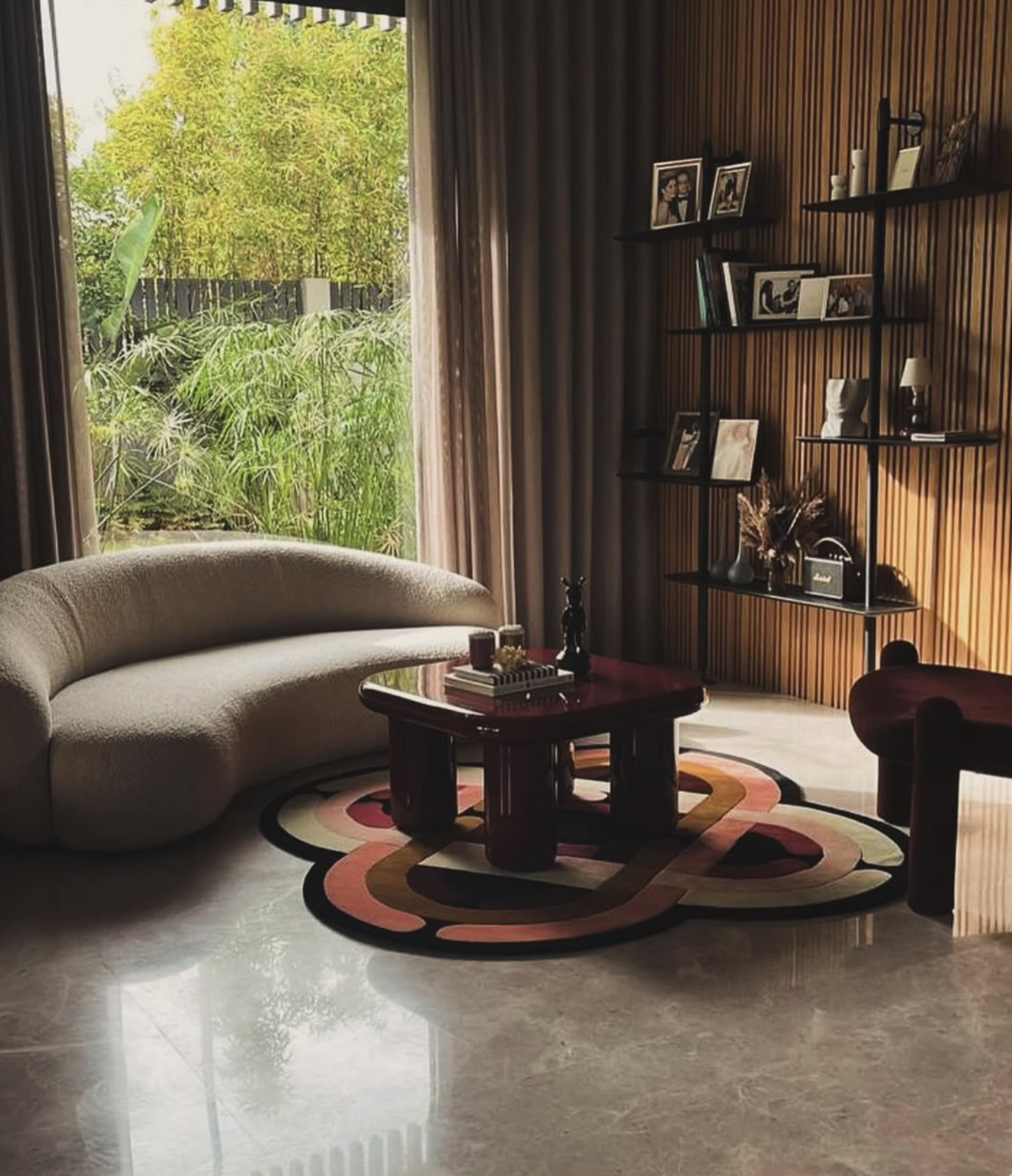
A rug knotted in Nepal folds, a rug tufted in India rolls. In an interior architecture project, this detail of transport heralds many others: choosing a rug for a hotel, a restaurant or an apartment is done with the site calendar, the technique, the material, and the story the architect or decorator will tell their client. Diacasan works with these specifiers on projects, from its collections or from a piece conceived for a place, with the workshops it has known for twenty-five years in Nepal and India, and with workshops in Italy and France for furniture and soft furnishings. What architects and decorators seek fits in a phrase of the house: “pieces with a story that can be told to the end client”. Each piece supplies its elements: an artist, a technique, a workshop, a lasting relationship.
What does an interior architect expect from a rug publisher?
He expects a coherent range, a simple relationship and the possibility of understanding what he specifies: who designed the piece, how it is made, where, and in how much time. This is what the architects and decorators with whom the house works say they seek, in France, in the United States or in the Middle East, and it is also what they most often find lacking in suppliers whose collections have no depth.
The house answers this by its very nature. It is a house of artists, not a rug dealer: each collection bears a signature, each record states the technique, the material, the country of making and the workshop, and a single point of contact follows the project from sample to delivery. The craft of the publisher, which consists in choosing the artist, the material and the workshop, then answering for the piece, is described in what is a rug publisher.
For projects abroad, provenance counts as much as the piece. The artists of the house are French, the house is Parisian, and this is often what American or Middle Eastern specifiers seek. Sandrine Demas formulates the ambition thus: “To become a French image that travels abroad, rather than a solely French brand.” A rug drawn in Paris, knotted in Nepal or tufted in India by long-standing partner workshops, then laid in a residence or a hotel on the other side of the world, carries this double story: that of a French taste and that of a craftsmanship come from the Orient.
Knotted or tufted: the technique is decided with the calendar
The site calendar often steers the technique even before the drawing. For a large hand-knotted format, allow four to six months of work; for a hotel lobby piece, not every client is prepared to wait that long.
Hand-knotting, carried out in Nepal in hand-spun Himalayan wool, is more supple, more rustic, and it acquires a patina over the years. It suits large residential projects and places where the piece must last and age with them. Since each point demands the same gesture, the complexity of the drawing weighs less on the price. It folds for transport, which simplifies the shipping of very large formats.
Hand-tufting, carried out in India, is quicker and stiffer; it does not fold and is transported rolled. It makes it possible to hold shorter lead times and very graphic drawings, and it remains artisanal work. Very pure New Zealand wool is used there for clean whites and ecrus, where the irregularity of Himalayan wool would give stains. European wools, worked in the workshops of Italy and France, call for the same vigilance on the purity of whites. The full comparison appears in hand-knotted, hand-tufted, and the detail of the techniques on the pages hand-knotting and hand-tufting.
A piece conceived for a place
The house speaks of projects: the piece is built with the specifier, from a plan, a use and a palette. It can start from an existing collection, adapted in a format or a colourway, or from a drawing particular to the place, and take the exact dimensions of the room that awaits it.
Before production, the workshops make samples: they allow the colour, the pile and the relief to be judged in the real light of the place, and adjustments to be made before launching the making. For VUE DU CIEL, the wools had thus to be adjusted so that they would hold the vibration of a field seen from above, each coloured field being composed of several shades. The Studio page presents this approach.
Which story to tell the end client?
That of the artist, the technique and the workshop, because it is true and can be verified on each record. A piece of the house is told in a few sentences, and that is precisely what a decorator who must convince his client seeks.
BESTIAIRE starts from an octopus seen by Christian Signorel in a mosaic at Pompeii, and the shape of the rugs comes from Greco-Roman cameos and Egyptian cartouches. SUR LE FIL translates the small-format engravings of Renaud Allirand into rugs hand-knotted in Nepal, in wool, hemp and silk. GRAND NORD begins with an image, the polar bear and the pack ice, and tips into reality when a tousled wool turns out to be the animal itself. VUE DU CIEL is born of the gaze of Sophie Tolachides, photographer and geographer, on an agricultural landscape seen from above. Each time, the same structure: an artist, a material, a country of making, a house that has worked with the same workshops for twenty-five years.
Places where the house's rugs are laid
The realisations show how a collection adapts to a use. In a restaurant opened in 2025 in the sixth arrondissement of Paris, the back room called for something generous, noticed without imposing itself: the CHAMP DE BLÉ rug, Sable colourway, from the VUE DU CIEL collection, found its place beneath the large table of raw wood. The Le Sahara restaurant features among the house's realisations.
In Varanasi, in India, a hotel wanted for one of its suites a piece that would converse with the spirituality of the place without imitating its codes: a NEPALESE RUGS piece knotted in Nepal answers the carved wood of the furniture. On the rue du Bac, in Paris, studio Messieurs signed in 2023 the scenography of the showroom, in limestone arches and niches, with an oval MINOTOR Cuivre that follows the curve of the large niche at the back. In a Haussmannian apartment in the seventh arrondissement, a decorator who is a friend of the house laid a PAINTINGS piece by Jean-Paul Espinosa on a period parquet, a project told in the rug in the Haussmannian apartment.
Beyond the rug: furniture and objects
A project can bring together the floor and what surrounds it, because several collections were conceived as ensembles. In GRAND NORD, the rug and the armchair were designed together by Messieurs: Iceberg armchairs, poufs and ottomans are built on a fir frame, in upholsterer's construction, in an Italian workshop. MINOTOR extends into round or oblong poufs, double-sided cushions and engraved Mircur mirrors, made in Italy. BESTIAIRE adds triptych mirrors in engraved walnut, poufs and cushions, and Christian Signorel's LUKAN fireside chair, in solid walnut-stained oak and cotton velvet, completes the ensemble. These extensions are presented in cushions, poufs, mirrors.
The pieces can be seen at the rue du Bac showroom, in Paris. Addresses and appointment arrangements are on the showrooms page.
Text written by the house of Diacasan Edition from interviews with Sandrine Demas on strategy and material, the realisations published on our website and exchanges with our workshops, October 2026.
Questions fréquentes
Which rug should be chosen for a restaurant?
A restaurant rug is chosen first for the place it occupies in the room and for the time the site allows. A hand-tufted rug, made more quickly, often makes it possible to hold the calendar of an opening; hand-knotting suits pieces meant to last and acquire a patina. In a restaurant in the sixth arrondissement of Paris, the house laid a CHAMP DE BLÉ in the Sable colourway beneath the large table of the back room. Material and care are then decided with the house, according to use.
Can a decorator have a rug made to the dimensions of a room?
Yes, within a project. The house can adapt a piece from its collections in a format or colourway suited to the place, or develop with the specifier a piece particular to the space, with its workshops in Nepal or India. Samples are made before production to approve the colour and the pile. The lead time depends on the technique: a few months for a tufted rug, four to six months for a large hand-knotted format.
What lead time should be planned for a large hand-knotted rug?
Allow four to six months of work for a large format hand-knotted in Nepal, because each point is knotted by hand and the making continues after the loom: washing, scraping, stretching, stabilising. Smaller collection pieces have lead times indicated on their record. For a site with tight deadlines, such as a hotel lobby, hand-tufting carried out in India is often the solution chosen.
Knotted or tufted: which to choose for a hotel?
It depends on the calendar, the format and the drawing. Hand-knotting from Nepal, supple and destined to acquire a patina, suits large residential projects and suites where the piece must last; it folds, which simplifies the transport of large formats. Hand-tufting from India holds shorter lead times and renders graphic drawings and clean whites in New Zealand wool very well. The house has, for example, laid a NEPALESE RUGS piece knotted in Nepal in a hotel suite in Varanasi.
Where can the Diacasan collections be seen in Paris?
At the rue du Bac showroom, in the seventh arrondissement of Paris, whose scenography was signed in 2023 by studio Messieurs. The rugs are shown there in niches that give each its own light, with part of the furniture and objects of the collections. It is the most fitting place to compare knotting and tufting by touch, and to judge a colour before specifying it. Contact details are on the showrooms page.