
Hallway and entrance, the rug that welcomes
A width to respect, doors to leave free, compact formats for the entrance and hallways conceived as projects: how to choose the rug that receives the first step.
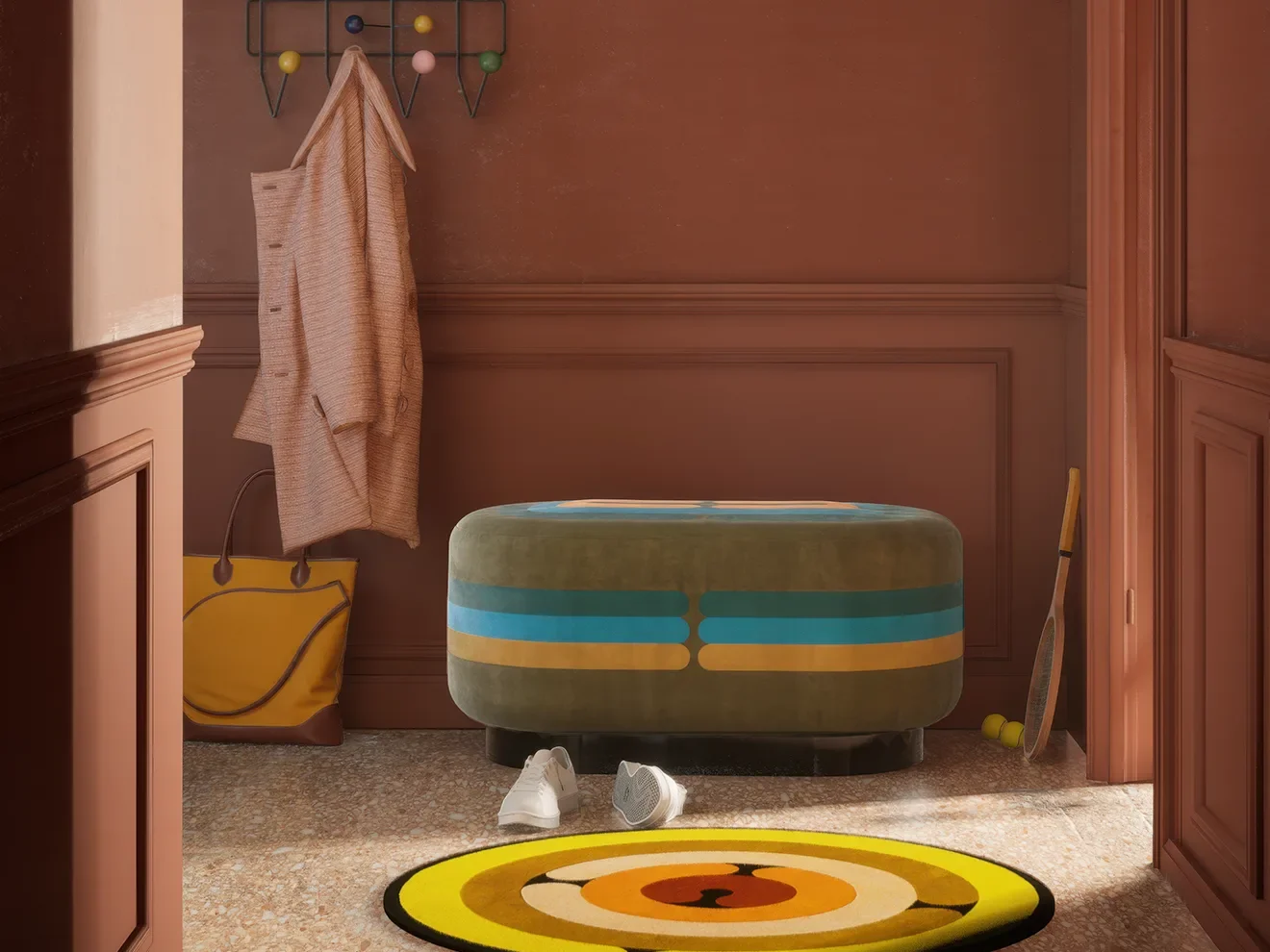
A rug hand-knotted in Nepal travels folded in a crate, and it is often through the entrance that it arrives. Yet the hallway and the entrance are the rooms where one measures least. In a hallway, the rug should leave at least 15 cm of floor visible on each side and stop before the doors, so that they open freely. In an entrance, it is chosen according to the door and the circulation: a compact format, rectangular, round or shaped, that receives the first step. Our catalogue has no hallway format in the strict sense, those long narrow strips also called runners. The small formats, on the other hand, answer the entrance: MINOTOR and MINOTOR 2.0 Oblong in 90 x 155 cm, BESTIAIRE in 90 x 150 cm, GRAND NORD in 100 x 150 cm, SUR LE FIL in 123 x 160 cm, MINOTOR Nef and round of 90 cm. For a long hallway, the rug becomes a project, established on the exact measurements of the passage.
In a hallway, the width commands
The width of the hallway fixes that of the rug, and it is the firmest measurement of the project. Furnishing guides advise leaving at least 15 cm of floor on each side. In a 110 cm hallway, the rug is therefore no more than 80 cm wide; in a 140 cm hallway, it can reach 110 cm. This border of parquet or stone gives the rug its frame and keeps it from rubbing against the skirting boards.
The length is then decided according to the doors. The rug must stop before each opening, without the door leaf lifting it. At both ends, we like to keep a band of floor of the same width, so that the rug appears laid at the centre of the passage rather than wedged against a wall. A very long hallway is sometimes better treated with two identical rugs, separated by a pause at a door, than with a single strip.
A hallway is looked at in enfilade, almost always from one of its ends. The rug is seen there in perspective, under a light that is often low, coming from a window at the end or an open door. It is there that hand-spun Himalayan wool shows what is particular to it: it catches the light differently according to the angle and the hour, and the same rug looks paler from one direction than from the other. A motif of long lines, laid along the axis, lengthens the passage further; a motif laid across cuts it into thresholds and shortens it to the eye.
Thickness also matters. A high pile, or a tousled wool like that of GRAND NORD, requires checking that the doors pass over it. The measurement is taken simply, door closed, between the bottom of the leaf and the floor.
Why the hallway goes through a project with us
Our drawings are published in proportions that belong to them, and none takes the form of a long strip today. The MINOTOR Oblong, elongated, accompanies a passage or borders a seat: in 90 x 155 cm, it dresses a short hallway or a landing. Beyond that, a hallway of several metres calls for a rug established to its exact measurements.
This work begins with a survey: width, length, location of the doors, direction of walking. The publisher then chooses, with the workshop, the technique that suits. Hand-knotting in Nepal, supple, folds and travels in a crate; it requires several months of work for a large surface. Hand-tufting in India, stiffer, travels rolled. In both cases, the motif must be rethought for a strip: a drawing conceived for a living-room rectangle is not cut into a ribbon.
Our article on the rug in an interior architecture project details this method, as we conduct it with architects and decorators.
The entrance, the first room one crosses
The entrance is the room where the rug is seen first and most often. It must fit in the clearance of the door, let the door open fully, and receive the step without forcing one to step over it. A compact format suffices in most entrances.
The front door almost always opens inwards, and its leaf describes an arc on the floor. Two solutions work: place the rug beyond this arc, or let it pass beneath, checking that the door glides over the pile without catching. Tracing with masking tape, door open then closed, settles the question in a minute.
Shape does a great deal here. A 90 cm diameter MINOTOR round sits at the centre of a square entrance and softens its angles. The 90 x 90 cm Nef, with its rounded lobes arranged in a cross, draws a threshold. BESTIAIRE, in 90 x 150 cm, takes its shape from Greco-Roman cameos and Egyptian cartouches: a silhouette read at a glance on entering. The MINOTOR 2.0 Oblong adds a relief that catches the light of a glazed entrance.
Slightly wider formats, such as the 100 x 150 cm of GRAND NORD or the 123 x 160 cm of SUR LE FIL, suit entrances that also serve as a vestibule, with a console, a bench, a mirror. The rug then gathers these pieces of furniture around it, as a living-room rug does around the sofa.
SUR LE FIL, hand-knotted in Nepal, suits the entrances of houses with stone or terracotta tile floors. Ramatuelle, one of its drawings, evokes a dry coastline and a horizon of pines: Renaud Allirand traces there a precise, straight motif, without ornament. Hemp forms the weft, Himalayan wool carries the colour, and the piece keeps the rigour of the engraving it comes from.
On the wall, a mirror often accompanies the entrance rug. The Mircur that Christian Signorel designed for MINOTOR exists in 69 cm diameter, a size that answers, at eye level, the 90 cm round laid on the floor. The gaze thus passes from floor to wall without changing drawing.
The entrance rug is laid inside, set back from the doormat, which keeps its role. One thus avoids asking a hand-spun wool to do the work of a scraper.
A wool that welcomes the steps
An entrance wears a rug faster than any other room. Wool has its place there, provided one accepts it as living. Hand-knotting in Nepal acquires a patina over time, like a fine piece of furniture, and takes the mark of passage without being damaged: this is the story our article on the rug that acquires a patina tells. An assertive drawing and a mid-tone colour hide comings and goings better than a plain ecru.
How the rug holds to the floor counts as much as the material. On a parquet or stone, an underlay prevents the rug from slipping and creasing underfoot. Furnishing guides advise cutting it a little smaller than the rug, by about 2.5 cm on each edge, so that it remains invisible. We gather the solutions in our article on what goes beneath a rug.
Seeing the format in the real space
The hallway and the entrance are poorly judged on a plan. The simplest course is to trace the format on the floor with masking tape, open each door, and walk on it for a few days. If the tracing gets in the way, the rug will too.
Our showrooms on the rue du Bac and the rue Cardinet then make it possible to see the small formats on the floor, to compare a round and an Oblong, to touch knotted wool and tufted wool.
One question remains, the only one that truly counts in an entrance: which drawing do you wish to find again each evening, on coming home?
Text written by Diacasan Edition from interviews with Sandrine Demas, the formats of our catalogue and exchanges with our workshops in Nepal and India, October 2026.
Sources: Wayfair, How to Choose the Right Rug Size: Your Rug Size Guide.
Questions fréquentes
What width of rug for a hallway?
The rug should leave at least 15 cm of floor visible on each side, according to furnishing guides. One therefore measures the width of the hallway and subtracts 30 cm: a 110 cm hallway takes a rug of 80 cm at most, a 140 cm hallway a rug of 110 cm. This border of floor frames the rug and keeps it away from the skirting boards. At Diacasan, a hallway rug to these measurements is conceived as a project, from the exact survey of the passage.
What length for a hallway rug?
The length depends on the doors. The rug must stop before each opening, so that the leaf passes without lifting it, and keep an equivalent band of floor at both ends. In a very long hallway, two identical rugs separated at a door are often more fitting than a single strip, and easier to care for. Before ordering, tracing the format with masking tape on the floor and opening each door makes it possible to check the measurement.
Which rug for an entrance?
A compact format, which lets the door open fully and receives the first step. In a square entrance, a 90 cm round or a 90 x 90 cm MINOTOR Nef softens the angles. In a longer entrance, a 90 x 155 cm Oblong or a 90 x 150 cm BESTIAIRE follows the circulation. When the entrance serves as a vestibule, with a console or a bench, a 100 x 150 cm or a 123 x 160 cm gathers the furniture. The rug is laid inside, after the doormat.
Can a wool rug be placed in an entrance?
Yes. Wool is the historic material of the rug and withstands passage, provided one accepts that it lives. A rug hand-knotted in Nepal acquires a patina over time, like a fine piece of furniture, and keeps its character. For an entrance, an assertive drawing and a mid-tone colour hide comings and goings better than a plain ecru. The doormat stays outside to hold back the bulk of dirt, and the rug, laid just after, receives a step already wiped.
How can a hallway rug be kept from slipping?
With a non-slip underlay, placed between the floor and the rug. Furnishing guides advise cutting it slightly smaller than the rug, by about 2.5 cm on each edge, so that it remains invisible. On a parquet or smooth stone, it also prevents the rug from creasing underfoot. The choice of underlay depends on the floor and the technique of the rug: our article on what goes beneath a rug details the options.