
What size of rug for the living room, and when the drawing decides the measure
From the seating area traced on the floor to the large formats knotted in Nepal and tufted in India, the method for choosing the size of a rug, and the drawings that impose their own measure.
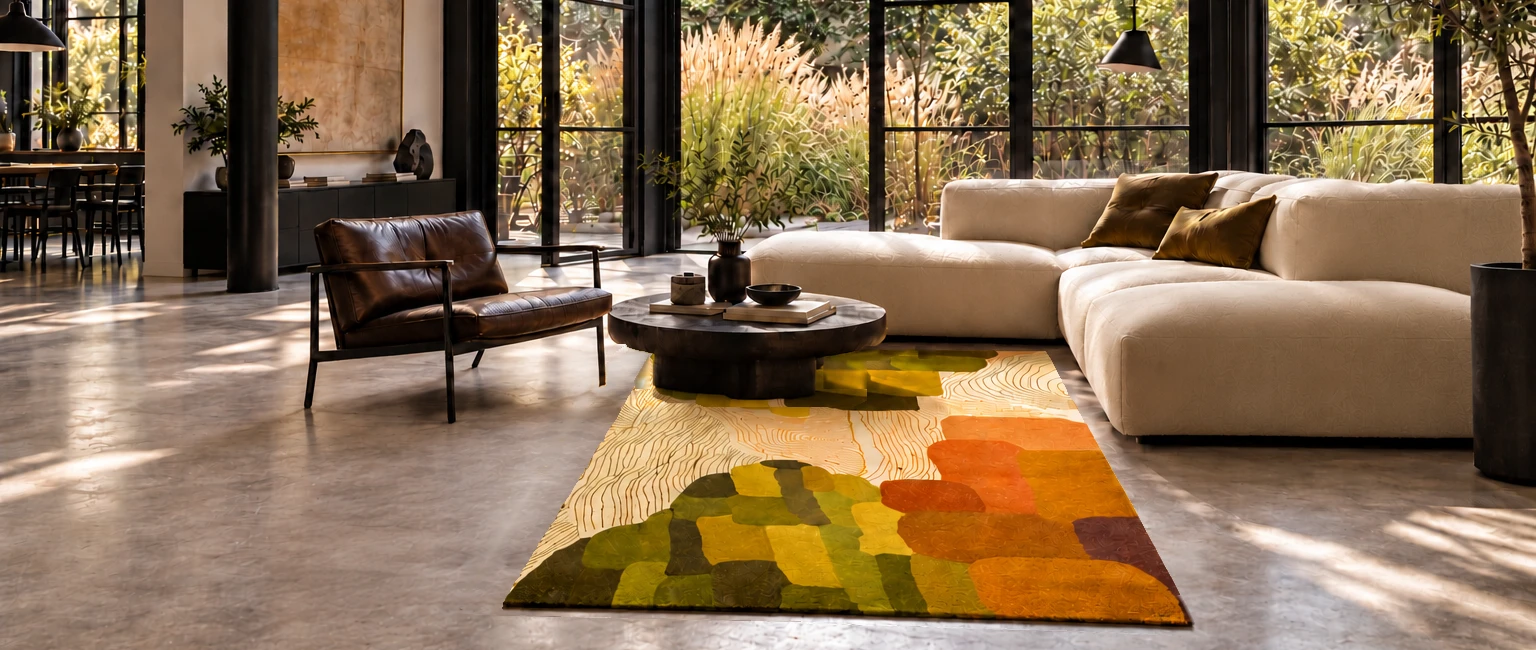
The tape measure first, the catalogue second. For a living room, the right rug is the one that unites the area where one sits: sofa, armchairs and coffee table should at least rest their front feet on the wool. In most living rooms, this leads to a 200 x 300 cm. When the sofa rests entirely on the rug, one must go up to 250 x 350 cm, or even 300 x 400 cm. The most widely cited furnishing guides, such as Wayfair's, then advise that the rug extend beyond the sofa by at least 15 cm on each side, and that 30 to 60 cm be added to the length and width of the measured seating area. At Diacasan, these formats exist in several collections, from hand-knotting in Nepal to hand-tufting in India. There remains what size charts ignore: some drawings have their own measure, and a MINOTOR Nef is not chosen like a simple rectangle. As a guide, a living room of 20 to 30 m² most often calls for a 200 x 300 cm, a living room of 30 to 40 m² a 250 x 350 cm, and beyond that the 300 x 400 cm or a Nef of 300 x 300 cm.
First measure the area where one sits
The format is calculated from the conversation area; the total surface of the room comes only second. The simplest way is to draw this area on the floor with masking tape, taking measurements outside the armrests and the feet of the armchairs, then to stand for a while looking at it.
Two arrangements work. In the first, all the seats rest on the rug: the living room seems calmer, more composed, and a large format is needed. In the second, only the front feet bite into the wool. This is the solution for living rooms where the sofa backs onto a wall or stands before a window.
An example. For a 240 cm sofa resting entirely on the rug, the margin of 15 cm on each side leads to at least 270 cm in the direction of the sofa: the 300 x 400 cm becomes the answer. For the same sofa placed with its front feet on, a 200 x 300 cm laid lengthwise leaves 30 cm of wool on either side.
There remains the room itself. A rug that touches the skirting boards gives the effect of wall-to-wall carpet; we like a band of floor to remain visible all around, wide enough for the parquet or stone to be part of the decor. In a 4 x 5 m living room, a 250 x 350 cm leaves 75 cm of floor on each edge. The small isolated rug under the coffee table, far from the seats, is in our eyes the most frequent mistake: it cuts the living room into islands instead of uniting it.
The formats we publish, collection by collection
Most of our collections follow the large rectangles expected in a living room, with variations that come from the drawing. Here are the dimensions listed in our catalogue in October 2026, in centimetres.
- NEPALESE RUGS, hand-knotted in Nepal: 170 x 240, 200 x 300, 250 x 350, and 300 x 400 for several models.
- SPATIAL, hand-knotted in Nepal: 200 x 300, 250 x 350, 300 x 400, and the round Bricks in 300 or 350 diameter.
- SUR LE FIL, hand-knotted in Nepal: 123 x 160, 160 x 210, 208 x 270, 256 x 336.
- PAINTINGS, hand-tufted in India: 170 x 240, 200 x 300, 250 x 350.
- GRAND NORD, hand-tufted: 100 x 150, 170 x 240, 200 x 300, 250 x 350.
- BESTIAIRE, hand-tufted in India: 90 x 150, 160 x 270, 190 x 325, 225 x 380.
- MINOTOR, hand-tufted in India: Nef from 90 x 90 to 300 x 300, Oblong from 90 x 155 to 200 x 350, round from 90 to 300 diameter.
- MINOTOR 2.0, hand-tufted in India: Nef in 200 x 200, 250 x 250 and 300 x 300, Oblong from 90 x 155 to 200 x 350.
- VUE DU CIEL, including CHAMP DE BLÉ and Rizière, hand-tufted in India: 170 x 260 and 200 x 340.
The 300 x 400 cm, often sought for large living rooms, belongs today to hand-knotting. In tufting, the largest pieces are the Nef in 300 x 300 cm and the round MINOTOR of 300 cm diameter. The measurements of SUR LE FIL, unusual, are particular to the collection: they compare directly with the seating area drawn on the floor. The 208 x 270 cm, for example, covers an intimate living room where the sofa and armchairs face each other closely, while the 256 x 336 cm approaches the large living-room formats.
When the drawing sets the measure
Some pieces have a right size, inscribed in the drawing as much as in the sofa. The Nef of MINOTOR is the clearest example: four rounded lobes arranged in a cross, placed at the centre of the living room to give it its axis. Its dimensions indicate its footprint on the floor, from edge to edge; the lobes therefore reveal more parquet than a square of the same measure. For the founder, the right size for the Nef by Christian Signorel is 300 x 300 cm.
The Oblong follows another logic. Elongated, it accompanies a passage or borders a seat, which makes it a sofa rug more than a centre rug. BESTIAIRE takes its shape from Greco-Roman cameos and Egyptian cartouches: a 225 x 380 cm cartouche before a long sofa draws a scene, where a rectangle would merely cover the floor.
The round, finally, suits almost square living rooms and circular coffee tables. MINOTOR publishes it up to 300 cm in diameter, SPATIAL in 300 and 350 cm with Emmanuel Thibault's Bricks drawing. At the rue du Bac showroom, it is an oval Minotor Cuivre that occupies the large niche at the back: a shape can decide a whole room.
Knotted or tufted, the large format travels differently
The technique changes the way a large rug enters your home. A rug hand-knotted in Nepal folds: washed, scraped, stretched on a frame during its making, it becomes supple enough to travel folded in a crate. Sandrine puts it simply: one unfolds it, it takes its place again, and a little walking over it is enough. A narrow staircase therefore rarely poses a problem.
Hand-tufting, stiffer, does not fold and travels rolled. Beyond 3 m, this roll requires special transport, considerably more costly, to be anticipated as soon as the format is chosen. Lead times differ too: a large knotted rug requires four to six months of work, while tufting, also artisanal, moves faster. Our page on hand-knotting in Nepal details the some fifteen stages that separate spinning from finishing.
Beyond the catalogue, the format becomes a project
When no measurement suits, the rug becomes a project. The exact dimensions of the room, the position of the windows, the circulation: everything is discussed with the publisher, starting from the drawing of one of our artists. A hand-knotted project for an architect's villa in Corsica thus reached 5 x 6 m. For architects and decorators, the method is described in our article on the rug in an interior architecture project, and the page devoted to the craft of a rug publisher explains why each piece starts from an artist.
The surest course remains to see the formats on the floor. Our showrooms on the rue du Bac and the rue Cardinet make it possible to unroll a 200 x 300 cm then a 250 x 350 cm in the same light, and to judge the difference by walking rather than on a plan.
A hand-knotted 300 x 400 cm is a hand-spun Himalayan wool and several months of knots, row after row, on a loom in Nepal.
Text written by the house of Diacasan Edition from interviews with Sandrine Demas, the dimensions listed in our catalogue and exchanges with our workshops in Nepal and India, October 2026.
Sources: Wayfair, How to Choose the Right Rug Size: Your Rug Size Guide.
Questions fréquentes
What size of rug for a living room of 20 m²?
For a room of about 20 m², a 200 x 300 cm is most often suitable, provided the seats rest at least their front feet on it. In a 4 x 5 m room, this format leaves 1 m of floor on each edge, which keeps air around the seating area. If the sofa must rest entirely on the wool, the 250 x 350 cm becomes preferable and still leaves 75 cm all around. The right criterion remains the size of the area where one sits, measured with tape on the floor.
Should the rug go under the sofa?
It should at least receive the front feet of the sofa and armchairs. This arrangement links the seats to one another and avoids the effect of a rug floating in the middle of the room. When space allows, placing all the seats on the rug gives a more composed living room; furnishing guides then advise that the rug extend beyond the sofa by about fifteen centimetres on each side. A sofa backing onto a window or a wall lends itself well to the front-feet solution.
What are the dimensions of a large living-room rug?
Beyond 200 x 300 cm, the large living-room formats are 250 x 350 cm, 300 x 400 cm and the 300 x 300 cm square. At Diacasan, the 300 x 400 cm is found in the collections hand-knotted in Nepal, NEPALESE RUGS and SPATIAL. In hand-tufting, the largest pieces are the Nef of MINOTOR and MINOTOR 2.0 in 300 x 300 cm and the round MINOTOR of 300 cm in diameter. For larger measurements, the rug is conceived as a project, from the exact dimensions of the room.
Round or rectangular rug in a living room?
The rectangle follows the shape of most living rooms and sofas: it is the simplest choice. The round suits almost square rooms, circular coffee tables and living rooms whose angles one wishes to soften. MINOTOR publishes a round of 250, 280 or 300 cm in diameter, SPATIAL a round Bricks of 300 or 350 cm. Between the two, Christian Signorel's Nef, formed of rounded lobes arranged in a cross, sits at the centre and gives the room its axis.
Can a rug be obtained in other dimensions?
Yes, within a project. When the catalogue formats do not match the room, we study the rug from its exact measurements, with the workshop that masters the chosen technique: in Nepal for hand-knotting, in India for hand-tufting. Lead times lengthen with the surface, up to four to six months for a large knotted rug. An appointment at the showroom, rue du Bac or rue Cardinet, makes it possible to start from an existing drawing and discuss its measure.
What size of rug for a living room of 30 m²?
In a living room of about 30 m², the 250 x 350 cm allows the sofa and armchairs to rest entirely on the wool while keeping a band of floor visible. If the seating area occupies only part of the room, a 200 x 300 cm suffices, front feet on. We publish the 250 x 350 cm hand-knotted in Nepal as well as hand-tufted in India.
For which living room should one choose a 200 x 300 rug?
The 200 x 300 cm is the most common format for living rooms of 20 to 30 m². It receives the front feet of a 240 cm sofa placed lengthwise, with 30 cm of wool on either side. We publish it in NEPALESE RUGS, SPATIAL, PAINTINGS and GRAND NORD.