
Relief in a rug, when the drawing takes on depth
The drawing of MINOTOR returns with another depth. What relief changes to a graphic motif, how it is made, and why it looks different at every hour.
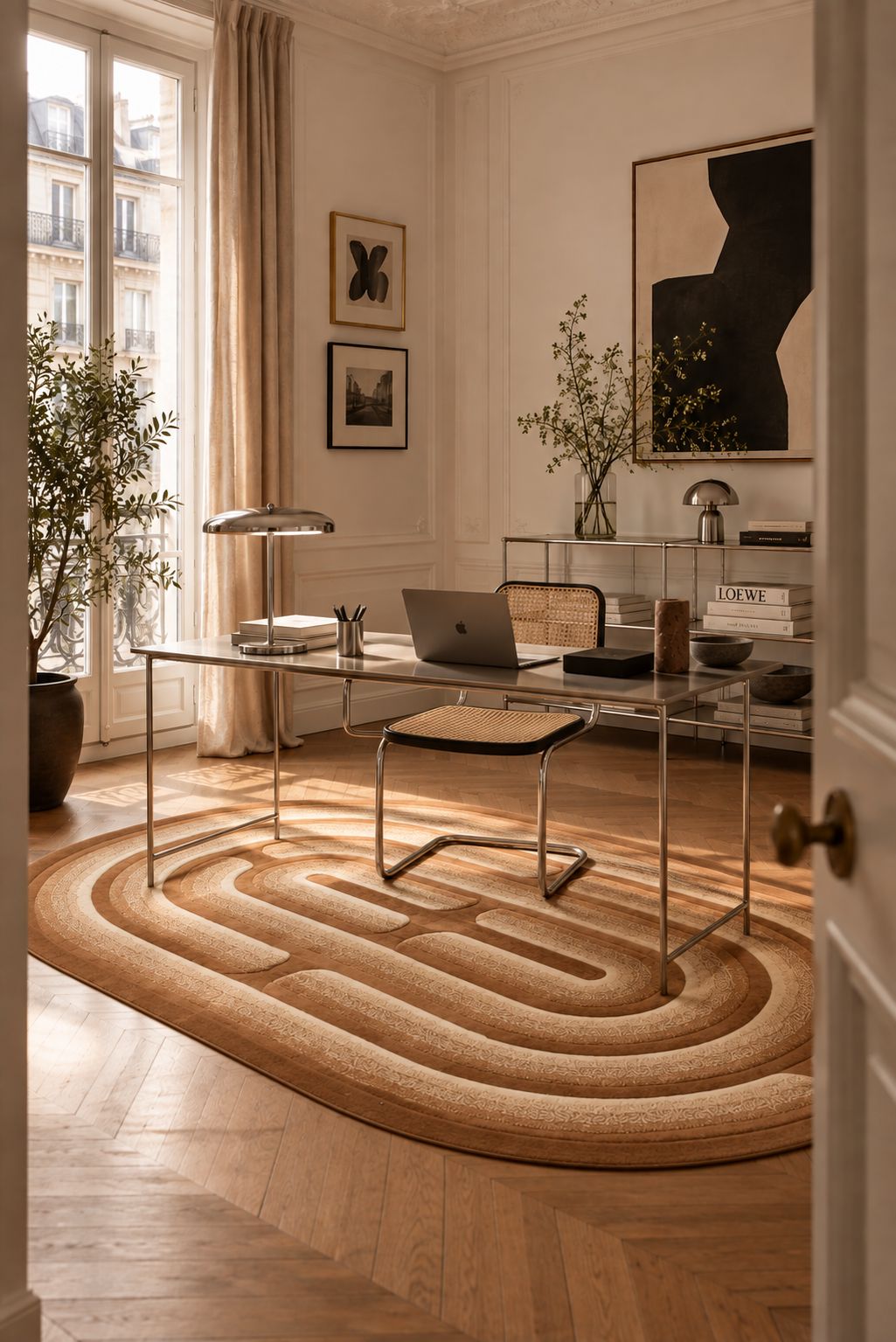
This season, the drawing of MINOTOR returns with only two colours and a new depth: relief. A relief rug is a rug whose drawing can also be read by touch, because the pile does not have the same height or the same construction everywhere. On a short-pile rug, the difference may be slight, and yet it is enough to bring out a line under the low light of a window. Relief is obtained in several ways: by carving the pile by hand after shearing, as tufting allows, or by playing on the weave of the rug so that the drawing appears only in pile, as we did in Nepal for a first knotted rug with a relief design. In every case, it changes the way one looks at a graphic motif. Colour carries the drawing, so does shadow, and the drawing moves with the hour.
What is called a relief rug?
A rug whose surface is not uniform, and whose drawing is built by this difference. In a hand-tufted rug, the Encyclopædia Universalis describes the stage that allows it: once the pile has been sheared to even it out, hand carving can accentuate the drawing and the reliefs. The artisan then hollows out the contour of a motif, detaches a form from its ground, and the line gains a shadow.
On a short pile, these effects remain discreet from the front. They appear when one walks around the rug, when the sun enters at an angle, when the hand passes over the surface. A relief is touched as much as it is looked at.
There is also a relief of the material itself, without carving or play of weave. In GRAND NORD, Messieurs found the polar bear in a generous, tousled New Zealand wool: the volume of the fibre makes the animal. In SPATIAL, hand-knotted in Nepal, Emmanuel Thibault moves away from the figure towards texture, mineral or vegetal. These pieces speak of relief in the broad sense, that of a surface that catches the hand. Drawn relief, the one that concerns us here, is more precise: it traces a line intended by the artist, in an exact place, and this line must hold from one edge of the rug to the other.
The first relief of the house was born in Nepal
Long before MINOTOR 2.0, the founder had explored what relief could do to a drawing. She then imagined a collection named Alnour, after a designer she had met before, and put a simple idea to her Nepalese workshop: to play with the weave of the rug so that the drawing would appear only in pile. The artisan thought it over, then sent a sample. It was convincing.
The raw sample, still without a drawing, was enough to convince a great name in furnishing to whom the publisher presented it. No one, on their side, had seen this technique. It opened for Diacasan one of its most lasting collaborations. The lesson remained: a relief can serve as a drawing, and a well-worked material can, on its own, carry a collection.
MINOTOR 2.0, the same drawing, another depth
Christian Signorel drew MINOTOR as a composition of lines, curves and geometric structures. Its formats are recognised at first glance: the round, the oblong and the nef, hand-tufted in India. Colours overlap there with density and fantasy. It has become one of the signatures of the house.
The question the house asked itself was delicate: how to evolve a piece that has become iconic? The artistic director's answer fits in a sentence: “it is the same drawing but the treatment is very different”. MINOTOR 2.0 keeps Christian Signorel's drawing as it is, whole. It removes the multiple colours to keep only two in each rug, and it brings in relief. The interlacing bands, the square held at the centre, the closed curves are now read through colour and through relief.
The Nef format closes four curves in relief around a centre; placed in the middle of a room, it gives the room its axis. The Oblong takes up the same form and stretches it: it accompanies a passage, borders a seat. The colourways are borrowed from stone, from Argile to Calacatta, by way of Schiste, Onyx, Levanto, Emperador and Azurite. Each rug is hand-tufted in India, in the workshop with which we have worked for twenty-five years.
Why relief serves a graphic drawing
Because it demands precision. A flat field of colour forgives a slightly slack line; a relief does not. With Christian Signorel, everything starts from the line, and Sandrine sums it up thus: “With him, everything is born of the line.” Relief extends this line into depth. It makes it tangible.
It also changes the relationship to colour. With only two shades, the drawing could become flat; relief gives it back volume, and each colourway, from the palest to the deepest, reads differently according to the lighting. For a graphic interior, a Parisian apartment with clean lines, it is a way of setting down a strong motif without weighing down the room. We return to this family of drawings in geometry, from MINOTOR to the line.
Technique, finally, is a publisher's choice. Hand-tufting leaves the artisan free to carve and work the surface; knotting, as Alnour showed, can carry relief through its very construction. We compare these gestures in hand-knotted or hand-tufted, and we explain what it means to choose a gesture for a drawing in the craft of a rug publisher.
A relief is looked at at every hour
In the morning, the light enters from the side and hollows each curve. At noon, it falls straight down, and the drawing becomes almost flat again, carried by its two colours. At the end of the day, the light returns from the side, warmer, and the shadows with it. The same rug, in the same place, shows several faces in a single day.
That is perhaps the true novelty of MINOTOR 2.0. Christian Signorel's drawing remains the one we know. The light redraws it at every hour.
Text written by the house of Diacasan Edition from conversations with Sandrine Demas on the genesis of the house and on MINOTOR, and from our exchanges with our Indian workshop, October 2026.
Questions fréquentes
What is a short-pile rug?
It is a rug whose pile is short, cut close to the base, as opposed to long-pile or tousled rugs. Its surface is crisp, easy to live with, and shows off graphic drawings with precise contours. On a short pile, the slightest difference in height or construction can be read in the light: that is why relief creates a fine effect there, which appears when one walks around the rug or when the sun enters at an angle.
How is a relief rug made?
There are several ways. In a hand-tufted rug, once the pile has been sheared to even it, hand carving can hollow out the contours of the drawing and accentuate its reliefs. In a knotted rug, one can play on the construction of the rug so that the drawing appears only in pile: this is how we developed, in Nepal, our first knotted rug with a relief design. The choice depends on the drawing, the material and the bearing sought.
Is a relief rug harder to care for?
It requires the same gestures as any other wool rug, with a little delicacy. For MINOTOR 2.0, our records ask for gentle vacuuming, protection from overly insistent sun, and leaving stains to a professional. As with our other wool rugs, it is best to vacuum without a rotating brush. Otherwise, the surface is lived with day to day like that of a short-pile rug.
Where should a relief rug be placed in a room?
Where the light can catch it at an angle. Near a window, the relief deepens in the morning and reveals itself differently in the evening. The Nef format of MINOTOR 2.0, placed at the centre of a room, gives it its axis; the Oblong, longer, accompanies a passage or borders a seat. In an interior with clean lines, a two-colour relief rug sets down a strong motif without weighing down the space.