
The dining-room rug, or the chair one pushes back
The margin to keep around the table, the calculations for round and rectangular tables, and what MINOTOR or CHAMP DE BLÉ teach about the rug laid beneath the dining table.
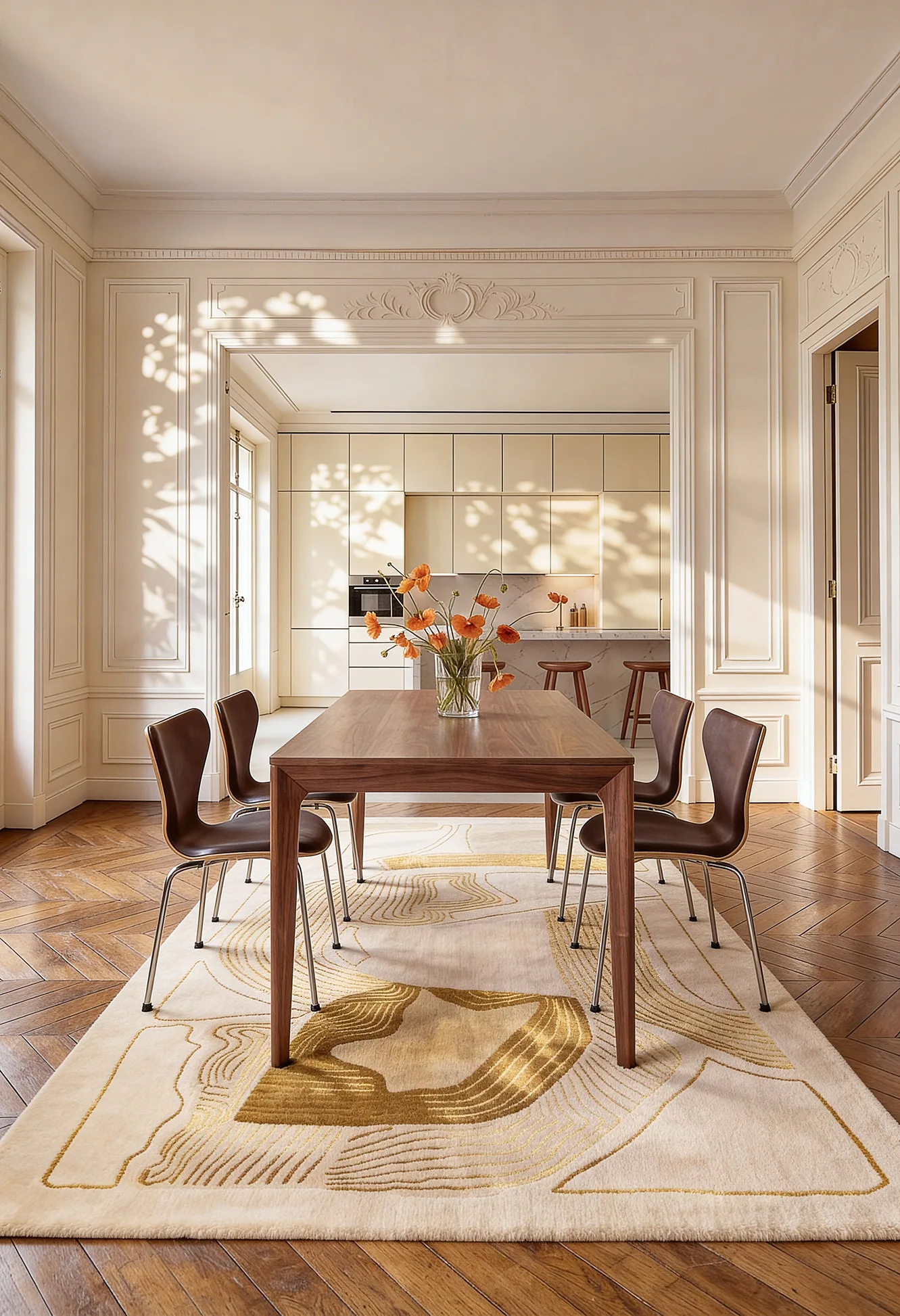
A chair pushed back in order to rise: it is the chair that sets the size of the rug. Beneath a dining table, the rug should extend beyond the top by about 60 to 90 cm on each side, so that the back legs of the chairs remain on the wool when one sits down or gets up. For a 180 x 90 cm table, the calculation gives at least 300 x 210 cm: the 250 x 350 cm is the right format, the 200 x 300 cm remains too narrow. A round table of 120 cm diameter calls for a round of at least 240 cm, such as the MINOTOR round of 250 or 280 cm. The dining-room rug is therefore chosen according to the table; the motif comes next. At Diacasan, the Nef, the Oblong, the round and the large knotted or tufted rectangles give several answers, which must always be checked with the chair pushed back.
The chair decides, the table gives the measure
The margin of 60 to 90 cm retained by furnishing guides corresponds to the space needed to push back a chair and rise without its back leg catching the edge. When the rug is too short, the chair tips slightly each time, the edge lifts and ends up marked.
The table therefore counts more than the room. One measures the top, adds the margin on every side where one sits, then checks that a band of floor remains between the rug and the walls or the storage furniture. A sideboard placed against a wall can stay off the rug: it is often cleaner that way. An extending table is measured open, since that is the position in which it receives the most chairs.
A few calculations, applied to the formats we publish:
- 160 x 90 cm table: at least 280 x 210 cm, that is a 250 x 350 cm;
- 200 x 100 cm table: at least 320 x 220 cm, the 250 x 350 cm still suffices;
- 240 x 100 cm table: at least 360 x 220 cm, a 300 x 400 cm is needed, hand-knotted in Nepal;
- 120 cm round table: a round of at least 240 cm, in 250 or 280 cm;
- 140 cm round table: a round of at least 260 cm, in 280 or 300 cm;
- narrow 180 x 80 cm table: at least 300 x 200 cm, which the 200 x 350 cm Oblong and the 200 x 340 cm of VUE DU CIEL cover.
A MINOTOR beneath the table rather than in the living room
When MINOTOR had to be shown in a Parisian apartment, Sandrine chose to lay it beneath a dining table. In the living room, it is expected; beneath the table, the drawing of Christian Signorel shows that it also holds in the room where people gather around a tabletop, and an apartment has both.
Geometry works here with the lines of the furniture. A rectangular table on a rectangle extends its own edges onto the floor, and the eye reads a single volume. A round table on a MINOTOR round does the opposite: the motif turns around the central foot and closes without a sharp edge. The Nef, formed of rounded lobes arranged in a cross, suits square or round tables placed at the centre of a room, provided one checks that the pushed-back chairs remain on the lobes and not in the hollows between them. In 250 x 250 or 300 x 300 cm, it gives the dining room its axis.
The Oblong, elongated, naturally accompanies a narrow table. Its rounded ends suit tables whose ends remain free or receive only a single seat. MINOTOR 2.0 takes up these formats with plays of relief: a relief is judged at the showroom, by drawing a chair across it, rather than on a photograph.
Knotted or tufted beneath a dining table
Both techniques are suitable, for different reasons. Hand-knotting, supple and dense, absorbs passage: the artistic director says it plainly, a knotted rug can endure a great deal and it acquires a patina, like a fine piece of furniture. The large formats needed beneath a long table, up to 300 x 400 cm, are found today in knotting, in NEPALESE RUGS and SPATIAL. They require four to six months of work in Nepal.
Hand-tufting, stiffer, is the technique of the MINOTOR shapes, the Nef, the Oblong and the round, as well as of CHAMP DE BLÉ. It is made in India, in the workshop we have followed since our founding journey of 2000. The very pure New Zealand wool used in India keeps pale tones clean; it remains to choose a pile one will know how to care for, and our guide to caring for a wool rug gathers what one needs to know.
When the dining room opens onto the living room
In an open space, the table rug defines the dining room better than a partition. It marks the place where people gather, and it softens sound: a wool pile absorbs the noise of chairs and voices as a curtain captures light, which one notices first in rooms with hard floors, stone, concrete or tiles.
Two rugs in the same volume must then answer each other. The surest course is to take them from the same family: a MINOTOR Nef in the living room and an Oblong from the same collection beneath the table, or two NEPALESE RUGS rectangles of different formats, knotted in the same Himalayan wool. Between the two, a clear band of floor, at least the width of a passage, keeps each space legible. Conversely, two strong drawings from different collections compete for the eye, unless one is seeking precisely that dialogue, which is then decided at the showroom, the two pieces side by side.
The height of the table also counts. Beneath a thick top and a massive table, a dense motif remains visible between the legs; beneath a glass table, the whole drawing is read, and it becomes the subject of the room. The CHAMP DE BLÉ rug, with its sinuous lines seen from the sky, or a MINOTOR round then take on another presence.
What a restaurant dining room teaches a dining room
The best test of a rug beneath a table remains a place open to the public. At the Le Sahara restaurant, on the Left Bank, a CHAMP DE BLÉ rug by Sophie Tolachides, in its Sable colourway, found its place beneath the large table of raw wood in the back room. The project called for a generous piece, noticed without imposing itself. The drawing, traced like an aerial view of fields, gives the floor a depth that the solid wood of the table lets breathe.
At home, the logic is the same, at another scale. The rug must extend well beyond the table, the colour must accept passage, and the motif can take a firm stance, since the table and chairs will hide part of it. If the room also serves as a living room, our article on the size of a living-room rug helps to distribute the formats between the two spaces.
To judge, nothing equals the chair itself. In our Paris showrooms, it is enough to lay a format on the floor, bring a chair onto it and push it back as if to rise from the table: the right rug is the one on which the back leg does not leave the wool. The page devoted to our craft as a rug publisher tells where the drawings laid in this way beneath a table come from.
In the back room of Le Sahara, the guests take their places above a wheat field seen from the sky.
Text written by the house of Diacasan Edition from interviews with Sandrine Demas, the formats of our catalogue and the projects followed with our workshops in India and Nepal, October 2026.
Sources: Wayfair, How to Choose the Right Rug Size: Your Rug Size Guide.
Questions fréquentes
What size of rug beneath a table for six?
It all depends on the dimensions of the table, which one measures before choosing. For a 180 x 90 cm table, one must add at least 60 cm on each side, that is a rug of at least 300 x 210 cm: the 250 x 350 cm is suitable, the 200 x 300 cm is too narrow. For a longer table, of 240 cm, one moves up to the 300 x 400 cm. The simplest test consists of pushing back a chair: its back leg must remain on the rug.
Which rug beneath a round table?
A round rug whose diameter exceeds that of the table by at least 120 cm, that is 60 cm on each side. A 120 cm table calls for a round of at least 240 cm; a 140 cm table, a round of 260 cm. MINOTOR publishes rounds of 250, 280 and 300 cm, SPATIAL a round Bricks of 300 and 350 cm, hand-knotted in Nepal. A square or a Nef of 250 x 250 cm also works beneath a round table, if the pushed-back chairs remain on the wool.
Should the rug extend beyond the table on all sides?
Yes, on every side where one sits. Furnishing guides retain a margin of 60 to 90 cm beyond the top, which corresponds to the space needed to push back a chair. A side occupied by a bench against the wall or by a sideboard can remain off the rug, provided the rug stays centred beneath the table. A margin wider than 90 cm adds nothing and reduces the band of floor visible around it.
Knotted or tufted: which rug beneath a dining table?
Both are suitable. Hand-knotting in Nepal is supple and dense, it withstands passage and acquires a patina over time; it is also the technique that covers the largest formats of the catalogue, up to 300 x 400 cm. Hand-tufting in India, stiffer, is the technique of the MINOTOR shapes: the Nef, the Oblong and the round. The choice is therefore made according to the size of the table, the shape desired and the lead time, longer for a large knotted rug.
Is a wool rug beneath a dining table reasonable?
Yes, provided it is chosen large enough and one accepts that it lives. Wool is the historic material of the rug, and a knotted rug acquires a patina over the years. Colour and motif count as much as material: an assertive drawing accepts the traces of daily life better than a pale flat field. At the Le Sahara restaurant, a tufted CHAMP DE BLÉ lives beneath a large table of raw wood. Our care advice is gathered in a dedicated article.