
The rug on the wall, when the piece is looked at face on
The children called it the shop where the lady is. In our showroom, every piece hangs on the wall and is seen face on, like a painting. How to hang a rug without damaging it.
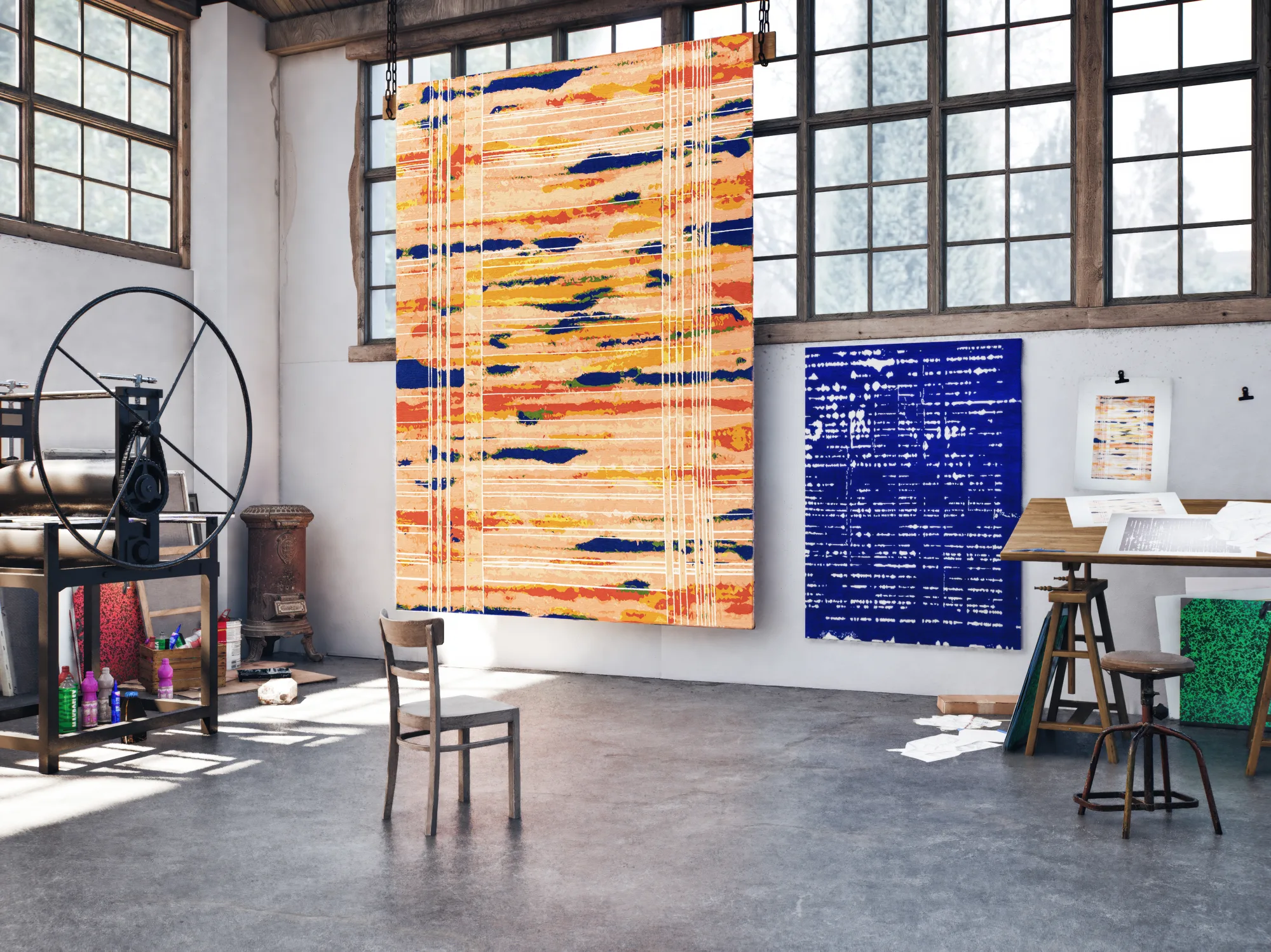
Can a rug be hung on the wall? Yes, provided it is in good condition, can bear its own weight and is given continuous support across its whole width. Textile conservators do this routinely for tapestries, wall hangings and rugs: the Canadian Conservation Institute describes a simple method, a hook-and-loop strip sewn onto a cotton sleeve, itself attached to the reverse of the rug, and a wooden batten screwed to the wall. Nails, tacks and staples driven into the piece are to be avoided, because they distort, tear or leave rust marks. For a piece from the house, one more precaution applies: the technique matters. A hand-knotted rug, supple, and a hand-tufted rug, stiffer, do not react in the same way when vertical, and the question is raised at the showroom before drilling. At Diacasan Edition, this is how we show our rugs: in the showroom, every piece hangs on the wall.
In the showroom, every piece is on the wall
At the end of the 2000s, the photographer Emmanuel Thibault signed a first rug with the house, Meteor Angel. The piece started from a photograph: a female figure, fabrics, an image translated into pile. In the showroom, it hung on the wall like all our pieces, at eye level, like a painting. The children passing in the street had noticed it. For them, it was the shop where the lady is.
The anecdote raises a smile, and it says something true. A rug at eye level attracts differently from a rug on the floor. One does not walk across it, one stops before it. Meteor Angel is today an archive piece: it belongs to the history of the house, which is not reissuing it for now. But this is still how we show our rugs: face on first, like images, before they find their place on the floor.
Rug or textile art: where does the line fall?
The line is blurred, and the house is comfortable with that. Asked about the words “contemporary art rug” and “rug as work of art”, the founder answers simply: “That is where we are.” Our pieces are signed by artists, published in small series rather than in numbered editions, and conceived for the floor as much as for the eye.
This is the case of SPATIAL. Emmanuel Thibault explores there a more abstract, more mineral territory, turned towards texture rather than the figure. “Where many people see only pebbles, I see molecules or solar systems; in broken glass, starlight; in the eyes of ants, the architectures of the next century,” he writes. These drawings are so detailed that the Nepal workshop must use its finest knotting, and even weave across the grain to render their details. Such work is read up close, at eye level.
The record of MINOTOR 2.0 says the same thing in other words: a composition “halfway between rug and work of art”. Christian Signorel's relief catches the light, which counts as much on a wall as on a parquet. This double reading, between the object one lives with and the work one looks at, is at bottom the work of a rug publisher.
How to hang a rug without damaging it?
The method recommended by the Canadian Conservation Institute rests on continuous support. A hook-and-loop strip has two faces, one with hooks, the other with loops. Since it is too stiff to be sewn directly onto the textile, the loop face is first sewn onto a sleeve of prewashed cotton or an undyed cotton tape. This sleeve is then hand-sewn to the reverse of the rug, about one centimetre from the top edge, from the centre outwards, with very small stitches.
The hook face, for its part, is stapled to a wooden batten about one centimetre thick, painted with acrylic and thoroughly dry, slightly longer than the strip. The batten is fixed to the wall, then the two faces are pressed together starting from the centre. For a heavy piece, a second strip placed in the middle of the reverse relieves the upper strip. To take it down, one slides a hand between the two faces, never pulling on the rug.
The advantage is twofold. The weight is spread across the whole width, with no point of load, and the rug can be taken down quickly. The method does not suit textiles that are too fine or fragile. The pieces of the house are wool rugs made to be walked upon; their actual weight deserves to be checked before choosing the width of the strip.
Knotted or tufted: what the technique changes
A rug hand-knotted in Nepal is supple. After the loom, it is washed, scraped, turned, laid out: it emerges so supple that a very large format folds into its crate and settles back into place once unfolded. A rug hand-tufted in India is stiffer; it travels rolled and does not fold. These two behaviours do not raise the same questions when vertical, and we prefer them to be raised piece by piece, at the showroom, rather than settled by a general rule.
One thing is certain. A rug lives better in place than rolled up in storage. Sandrine has observed it on pieces stored rolled for years without moving: they age less well than those that remain in place. Properly hung, a rug stays flat, supported, and continues to be seen.
Light, dust, insects: caring for a hung rug
Light damages all textiles, whether natural or artificial. It dries the fibres and changes the colours. A rug hung facing a window exposed to direct sun will age faster than the same rug in the shade of a partition; it is better to veil the neighbouring window or choose another wall. The Canadian Conservation Institute also notes that a hanging rug can attract more insects, which slip between the rug and its lining.
The rest is a matter of workshop common sense. A wooden batten, a hook-and-loop strip, a cotton sleeve, small-stitch sewing. The rug is on the wall.
Text written by the house of Diacasan Edition from interviews with Sandrine Demas, the records of our collections and the recommendations published by the Canadian Conservation Institute, October 2026.
Sources: Suspension des textiles à l'aide de bandes Velcro, Notes de l'Institut canadien de conservation 13/4; Soins de base, tapis et moquettes, Institut canadien de conservation.
Questions fréquentes
Can any rug be hung on the wall?
No. The rug must be in good condition and able to bear its own weight vertically. Textiles that are too fine, worn or fragile are not hung with this method. For a Diacasan piece, the technique also matters: a hand-knotted rug is supple, a hand-tufted rug stiffer, and we prefer to examine each case at the showroom, with the dimensions and the intended wall, before advising on hanging.
What is the best method for hanging a heavy rug?
The method recommended by textile conservators is the hook-and-loop strip. The loop face is sewn onto a cotton sleeve, itself sewn with small stitches to the reverse of the rug, near the top edge; the hook face is stapled to a wooden batten fixed to the wall. The weight is spread across the whole width. For a very heavy piece, a second strip in the middle of the reverse relieves the first.
Does a rug hung on the wall fade?
It can fade if the light is strong. Natural and artificial light alike dry the fibres and alter the colours of all textiles. Direct sun is the principal enemy: it is better to choose a wall that does not receive the rays of a window, or to veil the window. This precaution also applies to a rug laid on the floor, which can moreover be turned regularly.
Are nails or staples needed to fix a rug to the wall?
Certainly not in the rug itself. Nails, tacks and staples driven into the textile distort it, tear it or leave rust stains. Staples serve only to fix the hook strip to the wooden batten, and screws to fix this batten to the wall. The rug itself receives only discreet stitches, through a cotton sleeve that protects it.
What does Diacasan call textile art?
We publish artists' rugs, signed by their authors and published in small series. Some, such as those of the SPATIAL collection by Emmanuel Thibault or MINOTOR 2.0 by Christian Signorel, are as much surfaces to look at as floors to inhabit. This is why, in our showroom, every piece hangs on the wall: they are discovered face on, like paintings, before one chooses the piece that will find its place on the floor.