
What goes beneath a rug: the underlay
Felt, rubber, jute or foam: the underlay holds the rug to the floor and protects it from wear. What it does, how to choose it, and when it matters most.
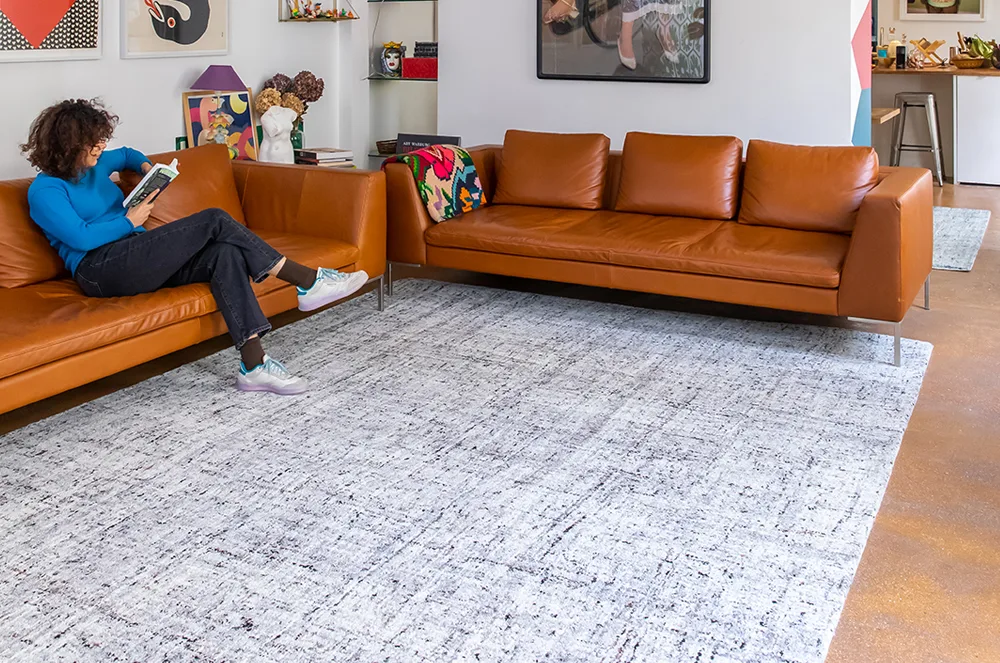
One unrolls a rug on a waxed parquet, takes a step, and it slides away with the foot. What slips beneath it to prevent this is called an underlay, known in French as a thibaude or sous-tapis. It is a layer of felt, rubber, jute or synthetic foam placed between the floor and the rug. Thibaude is the term preferred by terminologists; sous-tapis is used in everyday French. It has three effects: it holds the rug in place, it cushions the step, and it reduces the friction of the rug against a hard floor, which helps it better resist wear. The Office québécois de la langue française distinguishes two forms: the attached underlay, bonded to the rug, and the loose underlay, laid separately. Beneath a hand-knotted or hand-tufted rug, it is the loose underlay that serves, chosen according to the floor, the room and the technique of the rug.
What is an underlay for?
It serves first for safety. On tiles, polished concrete or a varnished parquet, a rug laid bare can slip at the first hurried step. A non-slip underlay holds it, including in a passage or at the foot of a staircase.
It serves next the rug itself. The lexicon of Centexbel, the Belgian technical centre for textiles, defines it as a layer that reduces the friction of the covering against a hard floor, with the effect of better resistance to wear and greater walking comfort. A rug that stays in place rubs less against the floor, and it keeps its shape better underfoot.
Felt, rubber, foam: which material?
The reference definitions cite the same families: hair and jute, felt, sponge rubber, urethane and polyurethane foams. Rubber works mainly on grip; felt and foams work on cushioning.
The choice is made from the floor. A hard, smooth floor calls first for grip. A rug laid on carpet, or a rug one wants softer underfoot, calls rather for cushioning. Thickness also matters for doors that must pass over it.
Knotted or tufted, the technique changes the question
Our rugs hand-knotted in Nepal are supple: they fold, which incidentally eases their transport. Our rugs hand-tufted in India are stiffer and do not fold. The technique of the rug therefore enters into the choice of underlay, just as the floor does. Hand-knotting is also more rustic to the touch, hand-tufting more even. The two crafts are presented on the pages the hand-knotted rug in Nepal and the hand-tufted rug in India.
On a heated floor, every layer counts
On underfloor heating, the underlay adds to the thickness of the rug and also slows the heat. The British maker Cormar, drawing on research by the UK underfloor heating manufacturers' association, recommends for carpet that the combined value of the covering and its underlay remain below 2.5 tog, the unit of thermal resistance used across the Channel. The question is treated in detail in our article on the wool rug and underfloor heating.
A well-chosen underlay is part of caring for a rug: it holds it, and it wears less. The other gestures, from vacuuming to stains, are gathered in our guide to caring for a wool rug. For a specific room, the best course remains to bring the dimensions and the nature of the floor to one of our Paris showrooms.
Text written by the house of Diacasan Edition, Parisian publisher of artists' rugs, from the terminological definitions and technical sources cited below, and from interviews with its founder on our techniques, October 2026.
Sources: Office québécois de la langue française, Grand dictionnaire terminologique, fiche thibaude; Centexbel, lexicon, Carpet underlay; Cormar Carpets, Tog values.
Questions fréquentes
What is an underlay?
An underlay is a layer placed beneath a rug to cushion and hold it. It is made of hair and jute, felt, sponge rubber, urethane or polyurethane foam. The Office québécois de la langue française makes thibaude the preferred French term, sous-tapis being used in certain contexts. One distinguishes the attached underlay, which is one with the rug, from the loose underlay, laid separately: it is the latter that is slipped beneath a hand-knotted or hand-tufted rug.
Underlay or non-slip rug pad: what is the difference?
They belong to the same family of accessories. Underlay is the trade term, rug pad the everyday one, and non-slip designates the function sought: preventing the rug from slipping. A non-slip pad emphasises grip, often thanks to rubber, while a felt or foam underlay emphasises cushioning. The choice between the two depends on the floor and the comfort sought.
Is an underlay needed beneath a wool rug?
On a hard, smooth floor, it is advisable. It holds the rug, which prevents slipping, and it reduces the friction of the rug against the floor, which helps it resist wear, according to the lexicon of the textile technical centre Centexbel. It also brings comfort underfoot. The model is chosen according to the floor, the room and the technique of the rug, a hand-knotted rug being more supple than a hand-tufted one.
Can an underlay be used on underfloor heating?
Yes, provided its thickness is taken into account. The underlay adds to the rug and also slows the spread of heat. The maker Cormar recommends, for carpet, that the combined value of the covering and its underlay remain below 2.5 tog. Some parquet manufacturers are stricter and advise against any rug on their heated floor. The floor's instructions and the installer's advice are authoritative before laying.