
Silk, vegetable silk, viscose: what sheen changes in a rug
Behind the name vegetable silk, viscose is most often hidden. The nature of the fibres, how they hold underfoot, their care: what sheen changes in a knotted or tufted rug.
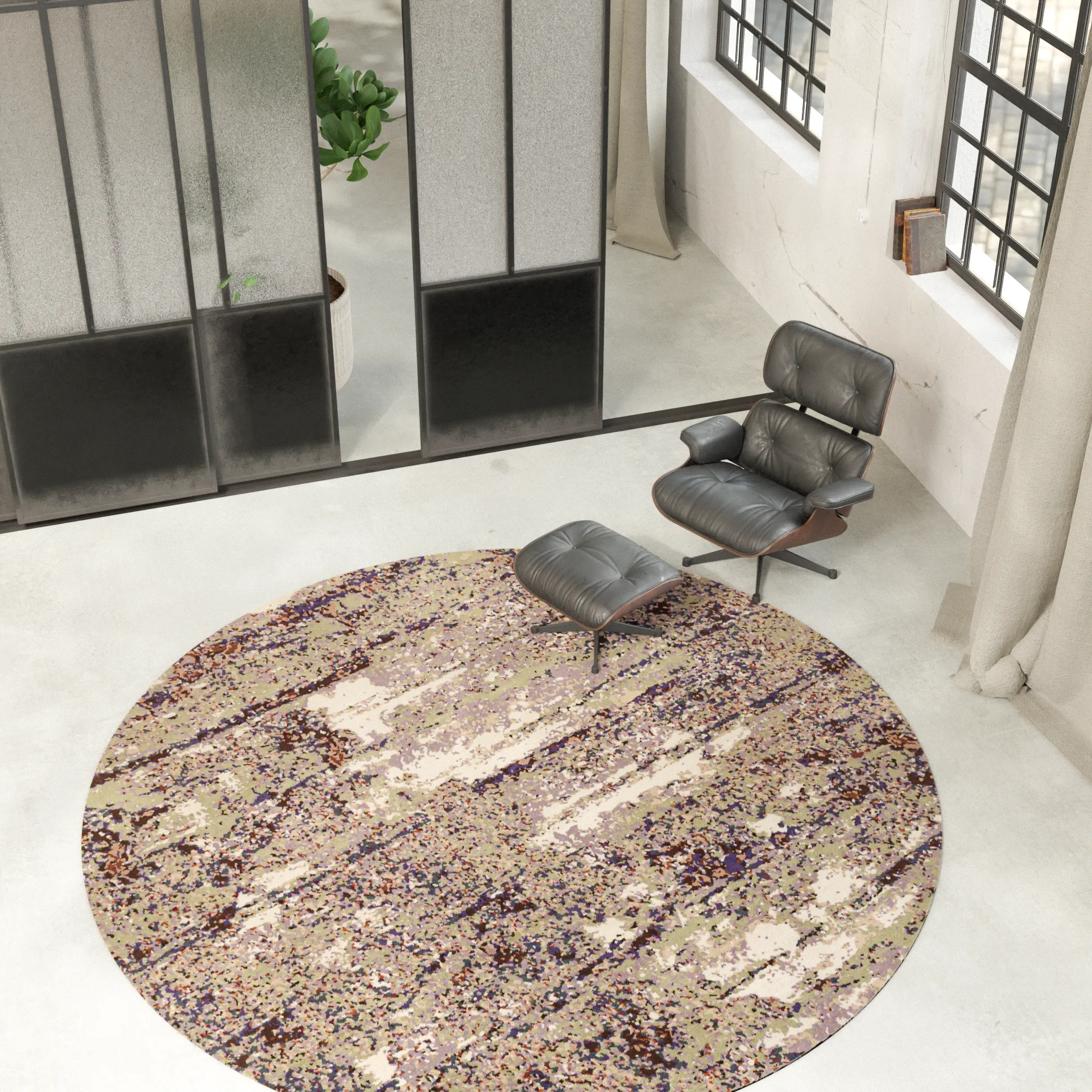
A rug sold as “bamboo silk” or “vegetable silk” is almost always in viscose, a fibre made by dissolving cellulose and then spinning it again. In the United States, the Federal Trade Commission requires these textiles to be called “rayon made from bamboo”, because no trace of the plant remains in the finished fibre. Silk is of another nature: a protein filament secreted by the silkworm. Tencel, the third name often encountered, is a brand of lyocell, another cellulose fibre drawn from wood pulp. All three share a sheen that wool does not possess. What separates them lies in the fineness of design they allow, in how they hold underfoot and in how they react to water. In our collections, wool remains the principal material; silk, viscose and Tencel come in to make light play on part of the motif, or on a whole piece when the artist asks for it.
Why a rug shines, or does not
Sheen depends first on the fibre. The Himalayan wool we have spun by hand in Nepal keeps an intended irregularity: it catches the light differently according to the angle and the hour, in small variations, without returning it in a single block. That is what one expects of a hand-knotted rug.
A fibre of silk or regenerated cellulose returns the light more frankly. Placed beside wool in the same rug, it becomes a drawing tool: a line, a flat field, a zone of the motif stands out depending on where one looks from. For those who choose a rug first for its colour, this is the difference that counts. Jean-Paul Espinosa, whose PAINTINGS collection expresses a joyful way of making colours vibrate, speaks of the rug as a territory: “a privileged, personal and reassuring place, where one can welcome one's friends and family”. On such a territory, the fibre decides how colour gives itself. A shade in wool holds as a block. The same shade, laid in a lustrous fibre, changes through the day.
Silk, an animal fibre reserved for detail
Silk is made of fibroin, a protein that the silkworm secretes in filaments as it spins its cocoon. Its thread is very fine. In a knotted rug, this fineness allows details that wool does not, and it also makes it one of the costliest materials of the craft. The artistic director of the house puts it plainly in interview: with silk, the thread is extremely fine, the rug becomes very sophisticated, and this segment is not the one Diacasan works in.
We therefore use it sparingly, in touches. In SUR LE FIL, Renaud Allirand's collection hand-knotted in Nepal, silk mingles with wool and hemp. It accompanies the passage of the engraver's line into the material, beside more rustic fibres that keep the rug's character. The pieces of the collection can be seen on the page SUR LE FIL, engravings by Renaud Allirand hand-knotted in Nepal.
Vegetable silk, bamboo silk: what the labels say
Bamboo, like wood, can serve as raw material for viscose. The Federal Trade Commission recalls that a textile may be called “bamboo” only if it is made directly of bamboo fibre. When the plant has been reduced to pulp then chemically transformed, the resulting fibre is a rayon, and it must be labelled “rayon (or viscose) made from bamboo”. The American authority adds that the process uses polluting chemicals, and that the finished fibre does not keep the properties of the plant: the antibacterial virtues attributed to bamboo do not pass into rayon, and any claim of this kind must be proven by testing.
Vegetable silk, bamboo silk, artificial silk: these trade names most often designate the same family of fibres. The exact composition, stated on a piece's record, remains the surest way of knowing what one is choosing. On our records, viscose is called viscose.
Viscose underfoot: a sheen that asks for consideration
Viscose gives a frank sheen, obtained through the chemical treatment of the fibre. It also has its fragilities, which Lisa Wagner, a rug cleaning specialist certified by the National Institute of Rug Cleaning, describes: weak fibres that passage and vacuuming end up tearing away, a dye that holds less well than on wool, a fibre that yellows easily when wet, a pile that can stiffen and tangle after cleaning. Over time and cleanings, she notes, the appearance of a viscose rug deteriorates faster than that of wool.
A viscose rug therefore finds its place where one walks little, and it is entrusted to a professional informed of its composition. We publish it knowingly. The Bricks rug by Emmanuel Thibault, SPATIAL collection, hand-knotted in Nepal, is made in wool or viscose: the same drawing, two lights, two ways of living on the floor. The collection explores an abstract and mineral territory, turned towards texture rather than the figure; the sheen of viscose serves the material there as much as the motif.
Tencel, a cellulose obtained differently
Tencel is a brand of lyocell, now held by the Lenzing group. Like viscose, it is a cellulose fibre drawn from wood pulp. Its making differs: the pulp is dissolved in a solvent recovered and reused in a closed loop, at more than 99% according to the manufacturer as cited by the Science Museum Group. Lenzing states that it sources FSC or PEFC certified wood and pulp, and the fibre is described as recyclable and biodegradable.
In our Indian workshops, Tencel is combined with wool in hand-tufted rugs. MINOTOR 2.0, Christian Signorel's new interpretation of one of the signatures of the house, plays on this dialogue between materials and light in its Oblong and Nef formats: the page MINOTOR 2.0, wool and Tencel hand-tufted in India shows its colourways borrowed from stone. The VUE DU CIEL collection by Sophie Tolachides likewise pairs New Zealand wool and Tencel. For certain pieces of PAINTINGS, the collection of Jean-Paul Espinosa, the artist holds to Tencel for its vibration; Sandrine also has them made in wool for clients who ask for it.
Living with a rug that shines
A lustrous fibre changes care as much as appearance. Wool tolerates water and the years: a hand-knotted rug can be washed, acquires a patina and ages well. Regenerated cellulose requires more precautions. The choice is therefore made on two levels: the light one wants to see on the floor, and the life the rug will have in the room. A living room crossed from morning to night does not ask for the same fibre as a bedroom or a wall.
Wool remains for us the noble material, and lustrous fibres accompany it. “We love beautiful materials,” says the publisher. Sheen is part of that, measured piece by piece, according to the artist's drawing and the use of the room where the rug will live.
The truest course remains to see the materials side by side, in daylight, and to walk around them. Our showrooms on the rue du Bac and the rue Cardinet lend themselves to this gaze: the Diacasan showrooms in Paris. The care gestures particular to each fibre are detailed in our article on caring for a wool rug.
Wool, hemp and silk for SUR LE FIL. Wool and Tencel for MINOTOR 2.0. With us, sheen is measured.
Text written by the house of Diacasan Edition, Parisian publisher of artists' rugs, from interviews with Sandrine Demas, the records of our collections and the technical sources cited below, October 2026.
Sources: Federal Trade Commission, How to Avoid Bamboozling Your Customers; SGS, US FTC fines companies for false labeling on so-called bamboo textiles (May 2022); Encyclopaedia Britannica, Fibroin; Lisa Wagner, Viscose rayon rugs, Cleanfax; Science Museum Group, Fibre production of Tencel.
Questions fréquentes
Is a bamboo silk rug made of silk?
No, in the vast majority of cases. Bamboo silk is a viscose: the plant is reduced to pulp, the cellulose is dissolved then spun again. The American Federal Trade Commission in fact forbids calling it simply “bamboo” and requires the mention “rayon made from bamboo”. Silk is an animal fibre, made of fibroin, a protein secreted by the silkworm. Both shine, but they have neither the same origin nor the same hold underfoot.
Is viscose a natural material?
Viscose starts from a natural material, the cellulose of wood or bamboo, but it is an artificial fibre: the cellulose is chemically dissolved then spun. According to the Federal Trade Commission, no trace of the original plant remains in the finished fibre, and the process uses polluting chemicals. It is called a regenerated cellulose fibre. Tencel belongs to the same family, with a different process in which the solvent is recovered in a closed loop.
Can a viscose rug be washed?
Not by oneself, and not with abundant water. Cellulose fibres yellow easily when wet, the dye holds less well than on wool, and the pile can stiffen after cleaning, according to the rug cleaning specialist Lisa Wagner. A stain is blotted without rubbing, then the rug is entrusted to a professional informed of its composition. A wool rug tolerates water much better, which partly explains the place we keep for it.
What is the difference between Tencel and viscose?
Both are cellulose fibres drawn from wood and spun after dissolution. Tencel is a brand of lyocell, held by the Lenzing group, made with a solvent recovered and reused in a closed loop, at more than 99% according to the manufacturer. Viscose is obtained by another chemical process. In a rug, both bring sheen. We combine Tencel with wool in rugs hand-tufted in India, notably in the MINOTOR 2.0 collection.
Why does a silk rug cost so much?
Because silk thread is very fine. It allows details of great fineness to be knotted, which multiplies the working time, and the material itself is costly. All-silk rugs form a separate, highly sophisticated segment, in which the house has chosen not to work. We use silk in touches, blended with wool and hemp, as in the SUR LE FIL collection by Renaud Allirand, hand-knotted in Nepal.