
Renaud Allirand: the engraver and the thread of time
Renaud Allirand is an engraver. Sandrine Demas waited for the right moment. His rugs keep the rigour of the engraved plate.
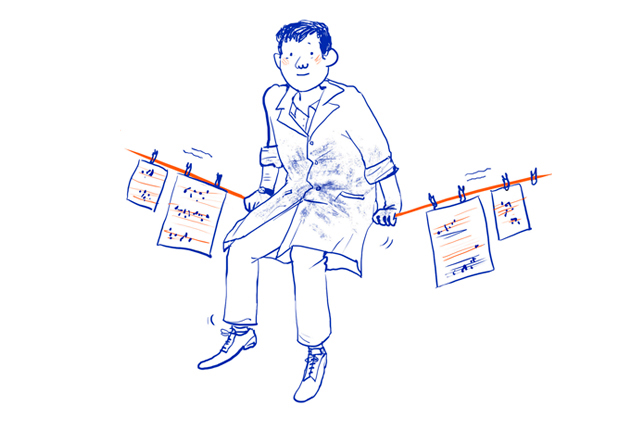
Between the first encounter and the start of the collaboration, there were years. Not forgetfulness. A ripening. Renaud Allirand and Diacasan took the time needed for the relationship to be right. And when it began, it was at the château de Tours, before an exhibition, that a discreet sign was enough to revive what had never truly stopped.
Renaud Allirand is an engraver. In the Diacasan catalogue, where photography, painting and drawing take pride of place, engraving is a discipline apart. Older. Slower. More radically bound to the resistance of the material. One does not engrave as one draws. One negotiates with the metal, with the acid, with the time the plate needs to reveal what it was asked to keep.
That slowness is not a flaw. It is a stance. It is perhaps what interested Sandrine Demas in his work: this way of not going fast, of not seeking the immediate effect, of building something that holds because it has been long considered.
The first encounter, and the time of silence
They crossed paths some ten years ago. The conversation took place, the interest was real. But the moment was not yet right. What followed was not a withdrawal: it was a pause. Diacasan kept Allirand in a corner of its memory. Allirand continued on his way.
The awakening came from an exhibition at the château de Tours. Sandrine Demas is there. She makes a sign. Discreet. Measured. Given at the right moment, in the right place. And everything begins again. Differently. Better.
This story says something important about the tempo of Diacasan. The house does not abandon the artists who interest it. It waits. Sometimes, waiting is the most just decision.
From plate to rug
The passage from engraving to rug is not self-evident. Perhaps even less so than from photography to textile, because engraving is an art of limit, of line, of hollow. Of what is missing as much as of what is there. How can this aesthetic be translated into knotted wool, into a soft surface, into an object destined to be walked upon?
The answer lies in precision. Allirand's rugs have the engraver's rigour: the lines are crisp, the flat fields frank, the compositions obey an inner logic that owes nothing to improvisation. And within this rigour there is an unexpected physical presence. Something that resembles warmth. Because rigour, when it is sincere, always ends up moving us.
Nepal as a creative partner
Allirand's rugs are made in Nepal. Hand-knotted. A technique particularly suited to variations of colour, which is precious for an artist whose work often plays out in nuance. Sandrine Demas made the journey. She filmed the production. She brought back images that tell what few clients imagine: behind each piece there are hands, a workshop, a craftsmanship rooted in a place.
That traceability is not only ethical. It is narrative. It is part of the story of the rug, of what gives it a depth that formal beauty alone cannot produce.
What Allirand's work brings to the house
In a publishing house that chooses its artists rather than multiplying them, each signature counts double. Allirand brings gravity. Verticality. This way of digging into a single idea until it becomes irrefutable.
His rugs do not shout. They hold. They settle into a room and transform it without seeming to. Like an engraved plate that has found its floor.