
Recognising a handmade rug, from the reverse to the fringes
Turning back a corner, following a fringe, folding the rug between the hands: the simple gestures that let one recognise a handmade rug, and tell a knotted rug from a tufted one.
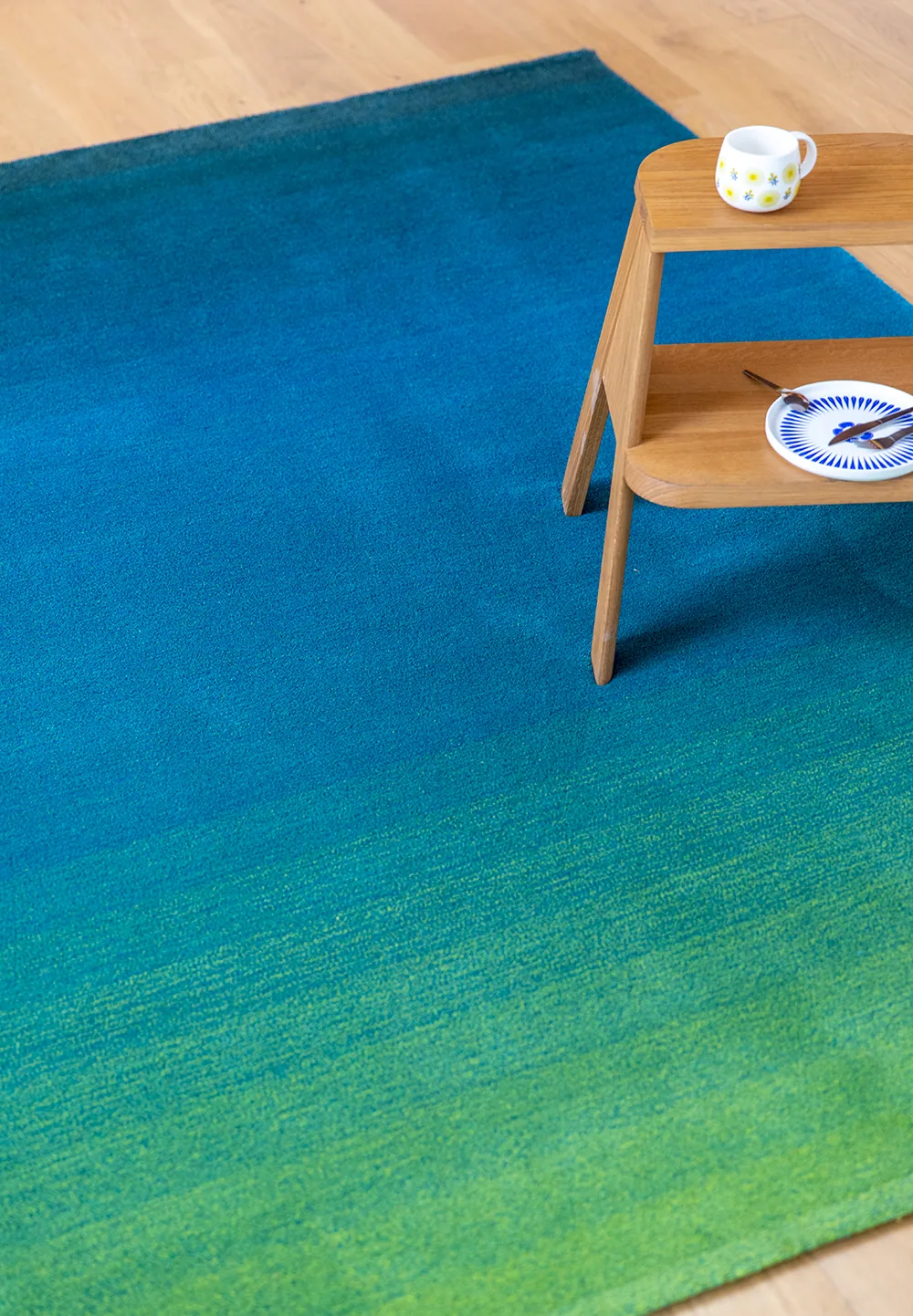
Lift a corner and turn it over. The reverse is the first witness of a handmade rug: on a hand-knotted rug, the design reappears on the back, knot by knot, without lining; on a hand-tufted rug, a canvas covers the reverse, but the pile was set by hand, piece by piece. Then come the fringes, which on a knotted rug are the warp threads themselves and not a sewn braid, then suppleness: a knotted rug folds without resistance. Slight irregularities, a colour that varies from one thread to another, a slightly lively edge, signal the hand rather than a flaw. Material, finally, says a great deal: a natural wool, well treated, does not turn grey after a year of use. None of these signs suffices alone. Together, they make it possible to distinguish an artisanal rug from a machine-made one, and a knotted rug from a tufted one. The surest course remains to ask the publisher for the technique, the country and the material of each piece, and to be able to touch it.
What does the reverse of a rug show?
The way it was built. On a hand-knotted rug, the back presents an almost inverted image of the front: the motif can be read there, the grid of knots can be made out, and nothing hides it. It is the most reliable sign, because it follows from the technique itself: each knotted point passes through the rug.
On a hand-tufted rug, the reverse carries a canvas. It covers the layer of latex that holds the wool set with the needle gun. A common belief holds that a canvas on the back designates an industrial rug. This is inaccurate: hand-tufting, an artisanal technique in its own right, always has a canvas-backed reverse. The canvas indicates only that the rug is not knotted.
The confusion comes partly from history. Hand-tufting arrived late in Europe. It was in 1974, according to the Encyclopædia Universalis, that hand-tufted rugs from Hong Kong appeared in France, and it was Cogolin that first adopted the process. From 1977, Sonia Delaunay championed the process with Artcurial, and many artists tried it in her wake. In 1985, the Salon des artistes décorateurs presented eighty-five artists' rugs, from galleries and publishers.
The machine-made rug, for its part, can be recognised by a very regular reverse, often lined, and by fibres held by glue rather than by a hand. We compare the two artisanal techniques in detail in hand-knotted or hand-tufted.
Are the fringes sewn on?
On a knotted rug, never. Its fringes are the ends of the warp threads on which the knots were placed: they run through the rug from end to end and are part of its structure. To cut them is to damage the rug. Pull gently on a fringe, follow it with your eyes: it disappears into the pile instead of stopping at the edge.
On a tufted rug, fringes, when there are any, are added last, fixed to the edge by stitching or glue. It is another construction. An added fringe therefore rules out knotting, while remaining compatible with hand-tufting.
Does the rug fold?
A knotted rug, yes. Washed, scraped, softened at the workshop, it lets itself be folded without damage, and it is thus, folded in a crate, that a large format travels from us. The tufted rug, stiffened by its canvas and gluing, is transported rolled.
This test, which can be made without damaging anything, at the showroom as at home, is the most telling of all: take a corner between your hands and fold it gently back on itself. The suppleness of a knotted rug is felt at once. This gesture is among those learned by handling Oriental rugs, which Sandrine did very early: her father worked in rugs, and, she says, “he initiated me into this world very early”. The Oriental pieces arrived in bulk; they had to be sorted, identified, read with the hands.
Are irregularities flaws?
Most often, they are proofs. A handmade rug does not have the regularity of a machine, and that is what marks it. In Nepal, our Himalayan wool is spun by hand, and this slightly uneven yarn gives a flat field a colour that moves with the angle and the hour. The specialist site Rugs.com also recalls it: a slight unevenness, a few knots a little less tight than others, indicate that a rug is handmade.
One must nevertheless distinguish intended irregularity from negligence. On a pale tufted rug, a shadow in the wool looks like a stain, which is why we use a very pure New Zealand wool there. The rug is read with the senses, and the eye quickly learns the difference. The rule fits in a sentence: irregularity must come from the material and the gesture, never from a lack of care. To follow these gestures one by one, read the journey of a knotted rug, from spun wool to finishing.
What does the material say?
Almost everything, with time. A natural wool, well chosen and well treated, softens and acquires a patina. A mediocre wool, or a so-called dead wool, taken from a dead animal, can look superb at purchase and then turn grey a year later. The founder saw, years ago, rugs from Turkey made of these wools: the difference could not be seen on the first day, only once the rug had met the air.
At first glance, one can already observe the hold of the pile, the touch of the wool, the clarity of the colours. For someone who has handled many rugs, the quality of a wool can even be seen with the naked eye. It is also useful to check the stated composition: a wool, a hemp, a silk, and their proportion. On each record of our collections, we indicate the technique, the country of making and the materials. Hand-knotted in Nepal, Himalayan wool and hemp. Hand-tufted in India, New Zealand wool. These words must be verifiable on the piece.
What to ask before buying?
Three questions suffice to judge a publisher: the technique, the place of making and the material. A handmade rug has a provenance, a workshop, a lead time. If it is knotted, ask how long it took: for a large piece, the knotting alone takes several months. If it is tufted, ask where and by whom. Ask also who designed it: a published piece bears an artist's name, Christian Signorel for MINOTOR, Renaud Allirand for SUR LE FIL, Emmanuel Thibault for SPATIAL, and that name commits the publisher as much as the workshop. Ask finally how to care for the piece. For our knotted SUR LE FIL rugs, for example, our records recommend vacuuming in the direction of the pile, without a rotating brush, turning the rug from time to time so that wear remains even, and, in case of a stain, blotting without rubbing before entrusting the piece to professional cleaning. A house that has worked for twenty-five years with the same workshops, in Nepal and India, knows how to answer these questions plainly. That is what distinguishes a rug publisher from a mere dealer.
Price, on its own, proves nothing. It follows from handwork time and material, and it is better understood once these answers have been obtained.
The simplest course remains to come and see, and to take one's time. In our showrooms, turn back a corner, fold a fringe between your fingers, run your hand over a knotted rug then over a tufted one. In a few minutes, the reverse will have taught you everything.
Text written by the house of Diacasan Edition from conversations with Sandrine Demas on material and craftsmanship, and from our exchanges with the workshops in Nepal and India, October 2026.
Sources: Tufenkian, Hand-tufted vs hand-knotted rugs; Rugs.com, How to tell a handmade rug from a machine-made rug; Encyclopædia Universalis, la vogue du tapis tufté.
Questions fréquentes
How can one tell whether a rug is hand-knotted?
Turn it over. On a hand-knotted rug, the design appears on the reverse almost as on the front, the grid of knots is visible and no canvas covers it. The fringes are the continuation of the warp threads; they disappear into the pile instead of being sewn to the edge. It also lets itself be folded in the hand without effort. If the reverse carries a canvas, the rug is not knotted: it may be hand-tufted, or machine-made.
Is a rug with a canvas on the reverse industrial?
Not necessarily. Hand-tufting, an artisanal technique, always has a canvas-backed reverse: the canvas covers the layer of latex that holds the wool, set by hand with a needle gun. A canvas on the back therefore means only that the rug is not knotted. To know whether it is handmade, one must look at the crispness of the work, the quality of the wool, and ask the publisher for the country and workshop of making.
Can a handmade rug have flaws?
It has irregularities, which is not the same thing. A hand-spun wool does not have a constant gauge, so the colour moves across a flat field. These variations signal the hand. A flaw, by contrast, comes from a lack of care or a mediocre material: a stain on a pale tone, a poorly held edge, a wool that turns grey. A serious publisher distinguishes the two and can explain each.
What is an artisanal rug?
It is a rug made by hand, piece by piece, by an artisan, and not woven in series on a machine. Hand-knotting and hand-tufting are its two great techniques. An artisanal rug has a precise provenance, a workshop, a making time, and a material that can be named. At Diacasan, our rugs are hand-knotted in Nepal or hand-tufted in India, with partner workshops of twenty-five years.
Is price enough to recognise a handmade rug?
No. Price follows from handwork time and material, but it proves nothing on its own: an expensive rug is not necessarily knotted, and a hand-tufted rug can cost less than a knotted one while being entirely artisanal. It is better to check the reverse, the fringes, the suppleness and the material, then ask the publisher for the technique, the country and the workshop. What this price covers is detailed in our article on the price of a knotted rug.