
When painting comes down to the floor: PAINTINGS by Jean-Paul Espinosa
Jean-Paul Espinosa paints on the floor. From his canvases, we isolate fragments that the workshop translates into wool or Tencel. So were born The Rose, then Everglades and the PAINTINGS collection.
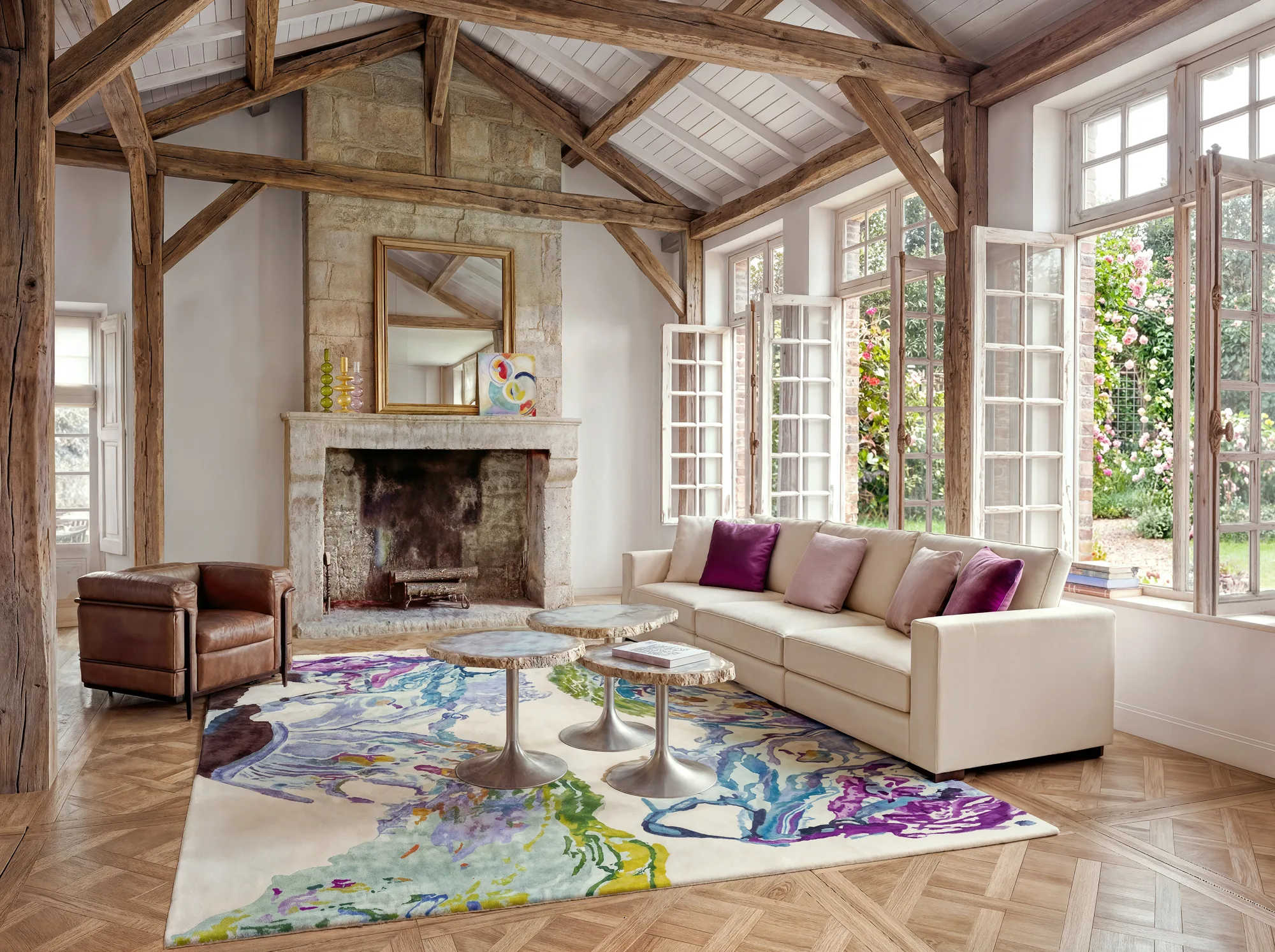
Jean-Paul Espinosa paints on the floor. The canvas is laid flat, colour is flung onto it more than placed, and it is in these rapid gestures that the rugs of the PAINTINGS collection are born. An abstract rug, at Diacasan Edition, is therefore first a fragment of painting. We isolate within a canvas a zone that holds on its own, we look at it at the scale of a floor, then our workshop in India translates it into hand-tufting, dividing the image into fields of colour that wool or Tencel can render. The first of these fragments is called The Rose. It did not depict a rose at the outset: only flashes of colour, in which someone thought they saw the flower, and the name stayed. Since then, the collection has grown in complexity up to Everglades, a very complex piece, which the workshop developed with us. Painting does not change its nature in coming down to the floor. It changes scale, material, and the way it is looked at.
How does a painting become a rug?
Through a series of choices. Jean-Paul Espinosa does not deliver a technical drawing: he brings his painting, sometimes his photograph, and it is for the house to find the rug within it. The first choice is the framing. In a teeming canvas, one must spot the fragment able to hold across two or three metres without losing its tension.
The second choice is the zones. A tufted rug is not made in continuous gradations: zones of colour must be determined, which the artisan will execute one after another. Our counterpart in India knows the rugs of Jean-Paul Espinosa well and knows how to isolate these zones in a painting. For the colours, the artistic director and the artist choose together pompoms of dyed wool, sent to the workshop with the image: this blue, that red.
Emmanuel Thibault, photographer and the artist's accomplice, often intervenes upstream. He photographs the canvases, reframes them, cleans the images so that they become usable. The Rose passed through his hands before reaching the workshop. The work is thus done by four hands, and the house brings them together.
Why hand-tufted in India, and not knotted in Nepal?
Because we tried, and knotting did not suit these creations. Hand-knotting excels in other handwritings, those of SPATIAL or SUR LE FIL. Espinosa's touch, made of rapid gestures and flung colours, called for another technique. Hand-tufting allows colour to be laid zone by zone.
Still, one had to learn to modulate this tufting. The work proceeded by trial and error: the artisans had to find how to render the artist's touch, and for each piece the same question returned, what to keep from the canvas, what to reinvent in the textile? Everglades is the most accomplished example. The piece is very complex; the workshop had prepared everything, then we spent time together adjusting it. This patience comes from the relationship: it is the same workshop, in India, with which the house has worked for twenty-five years.
Wool, Tencel or viscose: the material of the touch
The material decides how the painting glides across the floor. We made the test with Jean-Paul Espinosa. In wool, the pile took on a slight staccato, which does not suit this kind of drawing. The artist said he did not like it, and he was right. Tencel brings the fluidity that was missing.
The pieces of PAINTINGS therefore exist in several materials. Colorful and Everglades are made in wool or Tencel; Clairière in wool or viscose; The Rose and Forêt de Cristal in wool, Tencel or viscose. Some clients want them in wool, and we publish them that way for them. The choice belongs to whoever will live with the piece, once they have seen both.
The collection has also been sifted. Since The Rose, we have set aside certain pieces and kept those that best tell the painter's work. The Rose remains the emblem of the beginnings; Everglades shows how far the handwriting has developed since. Forêt de Cristal, which dates from the early days, has remained in the catalogue for this precise reason: it keeps the memory of a stage, and looking at it beside Everglades one measures the road travelled by the artist and by the workshop.
Colour as territory
With Jean-Paul Espinosa, colour is not a dressing. “Colour passes through me and I guide it,” he says. The tree, nature, the botanical return throughout his work: Clairière, Forêt de Cristal, Everglades bear the names of places one could enter. He himself defines the rug thus: “I conceive the rug as a territory: a privileged, personal and reassuring place, where one can welcome one's friends and family.”
This idea guided the way the collection is shown. Everglades was photographed on a jetty, at the water's edge, an idea of Sandrine's to give the piece the landscape its name calls for. The same world extends beyond the rug, with the Forêt de Cristal floor cushions, in 115 x 115, in white, yellow, blue and green.
Where does a painter's rug live?
Often where one does not expect it. In a Haussmannian apartment in Paris 7, redone by a decorator who is a friend of the house, the project called for a piece that would converse with the period parquet without supplanting it, something very colourful yet able to fall silent when needed. A PAINTINGS rug answered. It lives with cognac leather armchairs, white walls and high mouldings, without ever seeming out of place in this classical setting.
This rug has its audience. The admirer of Espinosa seeks a piece that vibrates, a colour that changes with the day, an emotion more than a demonstration. He is rarely the same as the admirer of Christian Signorel, and the publisher is amused by it: the two worlds do not touch the same people. This is precisely what the craft of a publisher allows: letting handwritings that do not resemble one another coexist, and finding for each the workshop that serves it.
A canvas on the floor, a fragment, a few pompoms of wool. Then the workshop.
Text written by the house of Diacasan Edition from interviews with Sandrine Demas, the records of the PAINTINGS collection and exchanges with our workshop in India, October 2026.
Questions fréquentes
What is an artist's abstract rug?
It is a rug whose design comes from an abstract work, a painting, photograph or engraving, rather than from a decorative motif. In the PAINTINGS collection, these are fragments of canvases by Jean-Paul Espinosa, chosen for their ability to hold at the scale of a floor, then translated into hand-tufting in India. Each piece is signed by the artist and published by the house, which chooses the framing, the colours and the material with him.
Can a painting be faithfully reproduced on a rug?
It is translated more than reproduced. A painting passes from one shade to another without a break; a tufted rug is built in zones of colour that the artisan executes one by one. One must therefore choose the zones, choose the wool shades with the help of samples, and accept reinventing certain passages in the textile. The result keeps the artist's touch, not the exactness of a photograph.
Why are some PAINTINGS rugs in Tencel?
Because Tencel better renders the fluidity of Jean-Paul Espinosa's painting. During the trials, wool gave the pile a slight staccato that did not suit these drawings, and the artist preferred Tencel. The pieces remain possible in wool, which some clients request. Depending on the model, the collection also exists in viscose. The best course is to compare the materials at the showroom.
Can a very colourful rug go in a classical interior?
Yes. In a Haussmannian apartment in the seventh arrondissement of Paris, a PAINTINGS rug lives with period parquet, cognac leather armchairs, white walls and high mouldings. The decorator was looking for a very colourful piece able to fall silent when needed. The key lies in the rest of the room: when the decor is restrained, the colour of the rug becomes the anchor of the whole instead of competing with it.
Who is Jean-Paul Espinosa?
Jean-Paul Espinosa is a visual artist from Lyon who creates objects on the border between art and design. He loves colour passionately and works it with spontaneity and breadth, often painting on the floor. His two favourite materials are the rug and light. At Diacasan, he signs the PAINTINGS collection, including The Rose, Clairière, Colorful, Everglades and Forêt de Cristal, hand-tufted in India.