
GRAND NORD, pack ice in the living room
It all begins in the workshop: the wool is tousled, and in it one sees the bear. The story of GRAND NORD, from the Nanuk rug to the Iceberg armchair, between pure white and arctic blue.
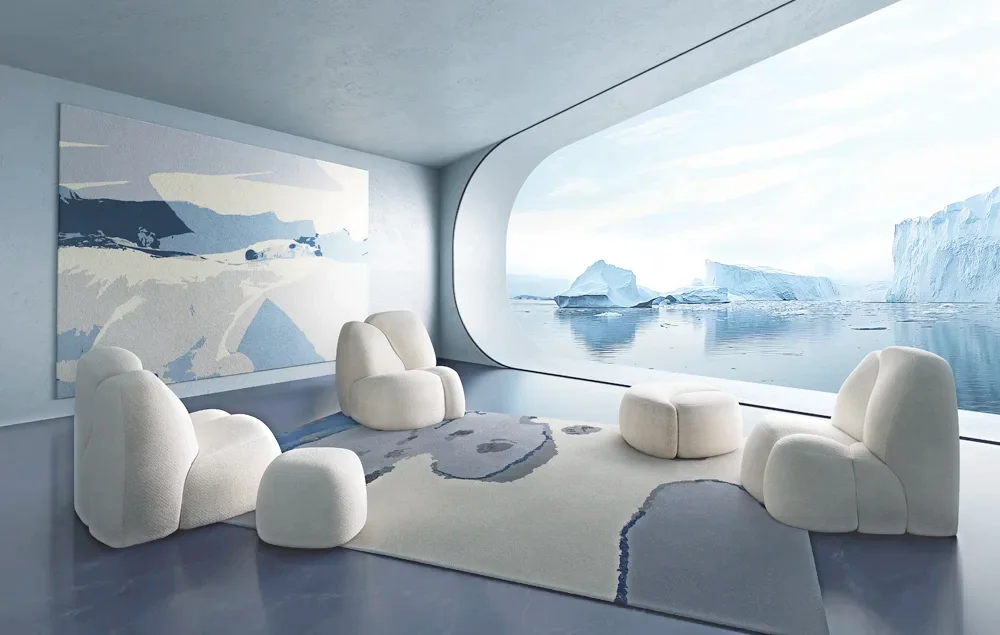
In a workshop, a sample of tousled wool, with an unremarkable design. Two people look at it. One asks the other whether she sees it too. The answer comes at once: one sees a bear. GRAND NORD was born of that instant, before any drawing. It is the collection of rugs and furniture that studio Messieurs signs for Diacasan Edition, and it is the one to look at when seeking a polar bear rug in which the animal lives in the material. The Nanuk rug carries the animal in its very substance: the generous, tousled wool serves as its fur. Around it, Arctique shows the bear swimming, Banquise its tracks, and the Iceberg armchair, the ottoman and the Ice Cube pouf extend the pack ice to seat height. The palette fits in a few words, white and an arctic blue. Winter suits it well.
The material before the drawing
GRAND NORD began with the material, and that is rare in the house. Ordinarily, an artist brings a drawing and we look for the workshop, the wool and the technique that will serve it. Here, the order was reversed. The artistic director was then looking for production in Europe and visiting a workshop that appealed to her at once, a place with a soul. What interested her was not what the workshop made, but what could be done with its tools. That is where the sample appeared.
It remained to know what to do with it. With a material this strong, a true drawing is needed, a design capable of carrying the wool. The house therefore wrote a brief, both precise and open. The polar bear, the pack ice, a world of ice and wild beauty. The rest belonged to the designers.
Why Messieurs?
Because their method always begins with a story. Messieurs is a design studio founded in Paris; each project there starts with a narrative, a mental setting, a scenario, before becoming an object. The studio knows the house well: it was the studio that conceived the scenography of the rue du Bac showroom, its limestone arches and deep niches.
The studio's imaginary world for GRAND NORD is precise: arctic landscapes, light bouncing off the ice, cabins of pale wood seen from the pack ice. Each piece, rug as well as armchair, keeps its trace, in a palette of bluish greys and brilliant whites, with motifs that recall the strata of ice. The studio has made of it a fragment of story that one can inhabit.
For GRAND NORD, the division of roles is clear. The designs are signed Messieurs. The artistic direction, the impulse and the choice of material come from the house. Sandrine sums up the studio's method in a sentence that appears on their page: “They told me the Far North before they drew it for me, and I believe it is that order which gives the collection all its strength.”
From the Nanuk rug to the Iceberg armchair
The collection was built around the bear, its totem animal. Nanuk is the central piece, the one in which wool becomes fur, published in four dimensions. Arctique and Banquise, published in three dimensions, render the animal through movement and through trace: the bear in the water, then the prints of its paws on the ice. The rugs are tufted in 100% wool.
Then came the desire for a seat. The request made to the studio fitted in a few words, “make me an iceberg”, and Messieurs entered into the game. The Iceberg armchair, which measures 95 cm wide and 107 cm high, became a centrepiece, strong enough that one looks at it before sitting in it. The Iceberg ottoman and the Ice Cube pouf complete the ensemble. All rest on a fir frame, built in upholsterer's construction, and are made in Italy, in a workshop that works in small series. They exist in two bouclette fabrics: Nanuk, in wool bouclette, and Excentric, a bouclette flecked with blue. The Iceberg cushions, square or rectangular, take up Excentric on one side and velvet on the other.
A white that must be watched
A white collection is a demanding collection. The white of a wool must be watched: it can drift towards yellow. During the development of GRAND NORD, a sample arrived with this drift. It was set aside at once: the collection demanded a pure white, without compromise, because it is the white that carries the light of the ice.
Arctic blue plays the opposite role. It answers the white and makes it stand out. A GRAND NORD cushion placed near a rug by Christian Signorel proves it: the two blues do not merge. That is intended. Each collection keeps its own light.
Bringing the pack ice into the living room
GRAND NORD works alone or in fragments. The Nanuk rug is enough to set the atmosphere; the Iceberg armchair placed upon it reveals the complete setting. The rugs go in living rooms, the armchairs in entrances, and the studio's handwriting takes over the room without cluttering it.
This autumn, we return to GRAND NORD. A collection takes time to settle; one must come back to it and have something new to say about it. This one gains from being seen when the cold arrives: the tousled wool, the white and the bouclette then take on their full meaning.
The collection also mingles with others. Today we like our collections to live together rather than in isolation, and we sometimes compose a living room with GRAND NORD and a SUR LE FIL rug by Renaud Allirand. Cushions and poufs are often the gateway to these pairings; we detail them in our article on cushions, poufs and mirrors. This freedom to bring different handwritings together belongs to the craft of a publisher, who chooses artists for what is singular in them.
Outside, it is freezing. Inside, the GRAND NORD collection keeps the white of the pack ice underfoot, tufted in pure wool, and an Iceberg armchair in upholsterer's construction, come from Italy.
Text written by the house of Diacasan Edition from interviews with Sandrine Demas and the records of the GRAND NORD collection, October 2026.
Questions fréquentes
Is there a polar bear rug at Diacasan?
Yes, the Nanuk rug from the GRAND NORD collection, designed by studio Messieurs. The bear is not merely depicted: it is the wool itself, generous and tousled, that evokes the fur. Nanuk is published in four dimensions and tufted in 100% wool. The collection also includes Arctique, the swimming bear, and Banquise, which takes up its tracks, as well as armchairs, ottomans, poufs and cushions in the same palette.
Who designed the GRAND NORD collection?
The pieces are signed by Messieurs, a design studio founded in Paris, whose method always starts from a story. The house brought the starting material, a tousled wool spotted in a workshop, and the brief: the polar bear, the pack ice, a world of ice. It also provided the artistic direction throughout the development. The studio had already conceived the scenography of our rue du Bac showroom.
What materials are the GRAND NORD rugs and furniture made of?
The rugs are tufted in 100% wool. The Iceberg armchair, the Iceberg ottoman and the Ice Cube pouf rest on a fir frame, in upholsterer's construction, and are made in Italy. They are dressed in two bouclette fabrics: Nanuk, in wool bouclette, and Excentric, a bouclette flecked with blue. The Iceberg cushions are double-sided, Excentric bouclette on one side and velvet on the other.
What are the dimensions of the GRAND NORD armchair and poufs?
The Iceberg armchair measures 95 cm wide, 102 cm deep and 107 cm high. The Iceberg ottoman measures 80 x 80 cm and 43 cm high, and the Ice Cube pouf 60 x 50 cm and 44 cm high. The Iceberg cushions exist as a 45 x 45 cm square and a 40 x 68 cm rectangle. The dimensions of the rugs can be found on each record or by asking the showroom.
Can GRAND NORD be combined with other collections?
Yes, and we gladly do so. Our collections are conceived to live together: an Iceberg armchair can accompany a SUR LE FIL rug hand-knotted in Nepal, and cushions or poufs often serve as the link between two worlds. The blue of GRAND NORD is not that of the other collections, which calls for a little attention in the pairings. The showroom allows the combinations to be tried before deciding.