
The colours of others: a chromatic journey through the world of Diacasan
Sandrine Demas puts it simply: the common denominator of the Diacasan artists is colour. A chromatic journey in four signatures.
Sandrine Demas says it without hesitation: the common denominator of all the Diacasan artists is colour. Not a palette. Not a colour chart. An inner disposition. A relationship to the world that can be read, above all, in the way each one chooses to tint it.
If one looks for what connects Jean-Paul Espinosa to Emmanuel Thibault, Thibault to Christian Signorel, Signorel to Renaud Allirand. What allows them to coexist in the Diacasan catalogue without contradicting one another. One will find it neither in style, nor in technique, nor in subject. One will find it in colour.
But take care. The colour Sandrine Demas speaks of is not an aesthetic convention. It is not a common shade, a shared range, an agreement signed between artists on what is allowed and what is not. It is something deeper, and harder to name. An intensity of relationship to the world. A way of inhabiting the light.
Espinosa: the forest as a chromatic laboratory
Jean-Paul Espinosa is the artist in whom colour is most immediately visible. The most declarative. His rugs do not murmur, they assert themselves. The greens are dense, the reds are vivid, the compositions evoke plants in full light, trees growing towards something.
Behind this apparent intensity lies a very constructed logic. The Paintings collection, born of fragments of painting recomposed into rugs, works as a mise en abyme: the colour of the canvas becomes the material of the textile, which in turn becomes the object of a new gaze. The Rose, an emblematic piece, concentrates in itself the whole vocabulary of Espinosa: formal generosity, depth of colour, a physical presence that resists indifference.
Thibault: colour through absence
Emmanuel Thibault works differently. A fashion photographer who became a Diacasan collaborator, he does not seek to saturate. He seeks to reveal. His compositions play with light more than with pigment. What makes colour in his work is often what surrounds it: a slightly veiled ground, a zone of shadow that brings out the gleam of a velvet, a framing that isolates a shade and gives it all the space.
Meteor Angel, his first collection for Diacasan, already set out this aesthetic. A photographed female figure, transposed into textile, with that particular ability of Thibault's to capture light as if it were a material.
Signorel: colour as a mythological universe
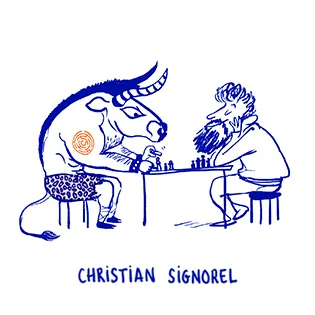
With Christian Signorel, colour is narrative. It tells something. It carries an imaginary world: that of the Minotaur, of the Bestiary, of the hybrid creatures that people his work and seem to belong to a time earlier than our own.
The Minotor collection, renamed Céleste for certain markets, is the most accomplished example of this approach. Eight colourways have been developed over time, five kept in the current catalogue. Each radically changes the reading of the piece: the same motif becomes now dramatic, now serene, now almost abstract depending on the shade chosen. Colour is not a dressing. It is an interpretation.
Allirand: blue as a territory
With Renaud Allirand, blue is worked like a territory.
Allirand is an engraver. His relationship to colour passes first through absence: the bite of acid on metal, the white of the paper that ink comes to invade. When this language is translated into rugs knotted in Nepal, something unexpected happens. The engraver's rigour meets the warmth of wool. What emerges is a piece with the precision of a master drawing and the presence of a living object.
That blue, deep, stable, almost architectural, resembles no other blue in the catalogue. It is a reminder that colour, here, is never an arbitrary choice.
A geography of light
Placed side by side, these four artists do not form a coherent palette in the usual sense of the term. Espinosa and Signorel saturate. Thibault suggests. Allirand carves. They do not share the same definition of red, nor the same idea of what blue means.
What unites them is something else. A certain conviction that colour is not decorative. That it is, on the contrary, the most serious thing one can put into a room. That to choose a shade is already to take a position in the world.
Sandrine Demas understood this before she knew how to put it into words. Perhaps that is why she says it so simply: the common denominator is colour. Self-evident, once one knows how to see it.