
The journey of a knotted rug, from spun wool to finishing
A hand-spun wool, dyed skeins, a loom, then water, the scraper and the frame: the journey of a rug knotted in Nepal, as we follow it with our workshop.
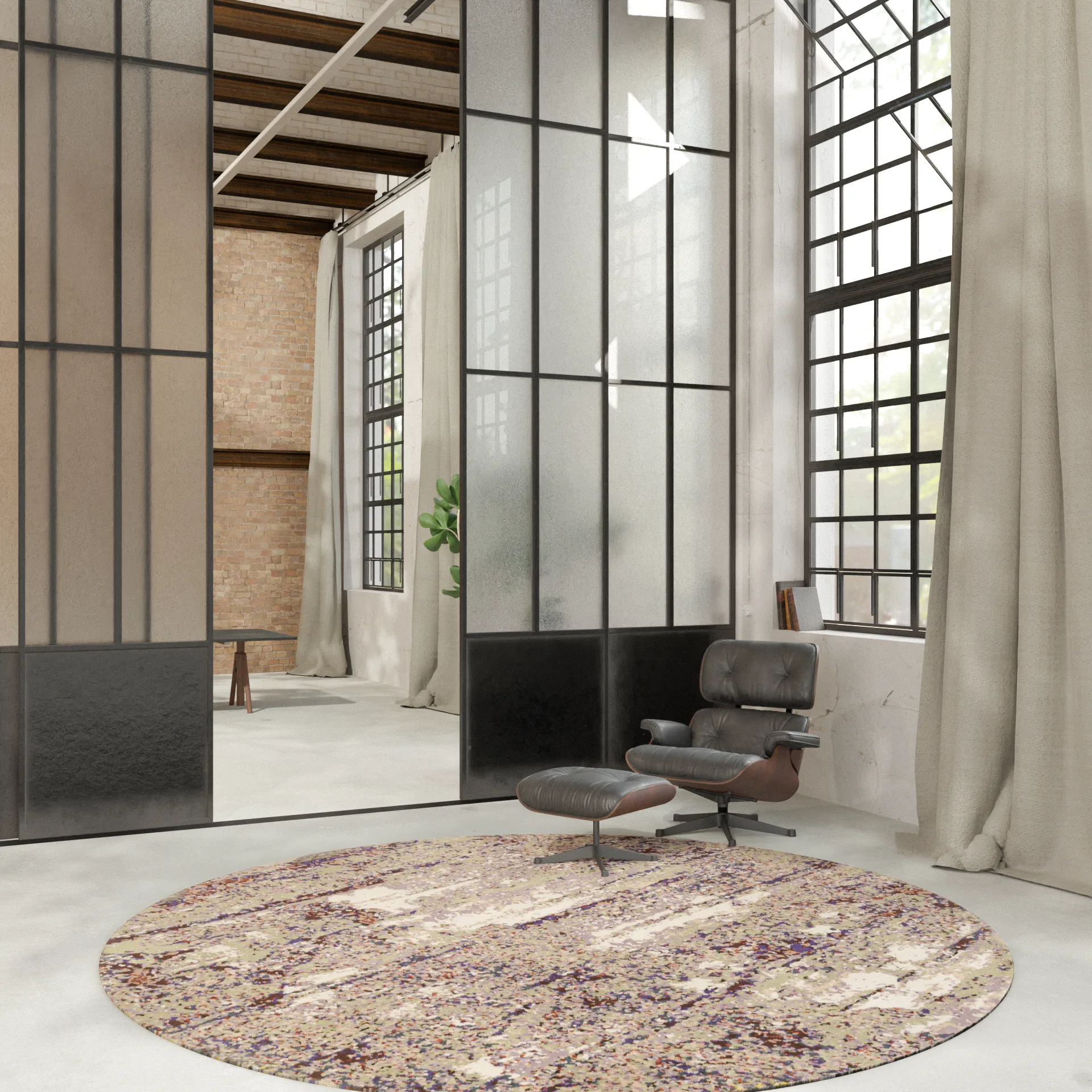
In Nepal, before the first knot, there is the wool. A hand-knotted rug follows a journey of some fifteen stages there. Himalayan wool is first spun by hand, then wound into skeins and dyed. It then goes onto the loom, where the artisan knots it point by point onto the warp threads, row after row, to the end of the design. Once the rug is finished, it is washed in tanks, scraped with a scraper, sprayed, turned over, then stretched on a frame that gives it its final shape. Each stage has its reason: spinning keeps the wool's irregularity, dyeing prepares the design, knotting builds it, washing rids the fibre of its impurities, the frame keeps it from buckling. This journey explains what one then feels under the hand, the suppleness that allows a large knotted rug to be folded, and the way it ages well. It is the one followed by the pieces we publish in Nepal, with a partner workshop of twenty-five years.
Why spin wool by hand?
To keep what the machine erases. In Nepal, it is mostly women who spin the wool, and the yarn they obtain remains slightly irregular. The workshop could mechanise this stage. We do not wish it to. The founder explains it plainly: hand-spinning “still keeps a certain irregularity in the wool that you smooth away when you mechanise things”.
This irregularity is barely visible on the yarn. It is very visible on the finished rug. A thread a little thicker here, finer there, takes the dye slightly differently and returns the light otherwise; the surface, even in a single colour, vibrates to the eye. The NEPALESE RUGS collection has made it its motif: broad fields of colour where hand-spun wool alone holds the surface.
The material itself has a history. Tibetan rugs were traditionally knotted from the wool of highland sheep, known as changpel; the workshops later founded in Nepal by foreigners favoured, according to Wikipedia, wools with longer fibres richer in lanolin. The same source notes that short-fibred wools, by contrast, pill more and felt after cleaning. The choice of fleece, even before spinning, therefore shapes the way the rug will live.
At the showroom, the difference is felt before it is understood. Run your hand against the grain of a knotted rug in Himalayan wool: the pile catches slightly, then springs back. That slight relief of the yarn is what hand-spinning has left behind.
Skeins and dyeing: colour is decided before the design
The yarn is gathered into skeins, those long loops that are plunged into the dye baths. It is at this moment that the rug's palette takes shape. The colours have been settled beforehand, from the artist's drawing and samples of dyed wool; the workshop reproduces them on the quantity of yarn the piece requires.
The history of the Himalayan rug recalls where this knowledge comes from. In the nineteenth century, according to the Wikipedia article on the Tibetan rug, reds came from madder, blues from indigo, yellows from Tibetan rhubarb, browns and greys from walnut; synthetic dyes arrived only at the beginning of the twentieth century. The same source recalls that the revival of the Tibetan rug, in the seventies, took place in Nepal and India. Nepalese knotting today descends from that history.
On the loom, point by point
Knotting is the longest stage. The warp threads are stretched on the loom; the artisan knots the wool onto them, one point after another, following the design colour by colour. The motif is therefore built within the very thickness of the rug, and that is why it reappears on the reverse. The Tibetan knotting technique, the same source recalls, also differs from those of the other rug traditions.
Time follows surface. For a large format, a piece for a residence or a hall, knotting extends over four to six months. Before launching a new piece, we ask for a sample: that is where one checks that a line holds at the scale of the floor, that a colour keeps its accuracy once knotted. This is how a small-format engraving by Renaud Allirand becomes, in SUR LE FIL, a hand-knotted rug of wool, hemp and silk.
Some designs remain on the workshop's looms for a long time. Mikado, one of Sandrine's first designs, is still knotted in Nepal in NEPALESE RUGS, with its sticks cast in a sheaf and its broad fields of colour. A design that crosses the years without changing hands: that too is the long tempo of knotting.
Washing, scraping, turning
The rug that leaves the loom still awaits its finishing. It is washed, in tanks made for the purpose, which clearly distinguishes it from a tufted rug, which is not washed. Then comes a series of repeated gestures: the artisans scrape the rug with a scraper, spray it again, turn it over, begin again.
These operations remove impurities from the fibre and set the whole. The colour will no longer move. The rug also gains a resilience that matters for the rest of its life: a knotted rug treated in this way withstands a great deal, and it ages well. A new rug emerging from these baths has already lost the impurities the fibre carried; it reaches its owner clean, softened, ready to be walked upon. That is where the patina we speak of in a rug acquires a patina comes from.
The frame gives the shape
The last stage before departure: stretching. The rug, still damp, is stretched on a frame, edge to edge, to take its final shape. Without this tension, it would dry buckled, rippling over its whole surface.
The same principle holds, years later, for whoever lives with the piece. A knotted rug can be washed. Simply dried flat in a garden, however, it risks remaining a little wavy, for want of having been stretched again. This is one of the reasons why our records recommend professional cleaning in case of a stain, as we will detail in caring for a wool rug.
In all, there are some fifteen stages. The publisher says it in her own words: “there are some fifteen stages to reach the end of the road”. She learned to read a rug from Oriental rugs, long before founding the house, and it is still that eye which lets her recognise a good workshop in Nepal.
What this journey changes for those who live with the rug
It changes the touch first. Washed, scraped, softened, the knotted rug falls like a heavy cloth. The surface keeps the trace of hand-spinning: up close, one sees the slightly uneven threads; from afar, a colour that moves with the hour. It also changes the way it travels. A large knotted rug folds; it leaves the workshop folded in a crate, and once laid, a few steps are enough to flatten it again. A tufted rug, stiffer, travels rolled. We compare these two gestures in hand-knotted or hand-tufted.
It changes, finally, the way one looks at the piece. A knotted rug is not the image of a drawing laid on the floor: it is a sequence of decisions, taken from spinning to the tension of the frame, each of which leaves its trace. These gestures are those of the Oriental rug, which is why the artistic director likes to repeat: “Nepal is the Oriental rug of today.” This is what we mean by publishing, and what our page on the craft of a rug publisher recounts.
It remains only to fold it upon itself. The rug enters its crate and leaves the workshop.
Text written by the house of Diacasan Edition from conversations with Sandrine Demas on material and making, and from our exchanges with the Nepalese workshop that knots our pieces, October 2026.
Sources: Wikipedia, Tibetan rug.
Questions fréquentes
How many stages does it take to make a knotted rug?
Some fifteen, from spinning to shaping. The wool is spun by hand, gathered into skeins, dyed, then knotted point by point on the loom, which remains the longest stage: four to six months for a large piece. Then come washing in tanks, scraping, spraying, turning, and finally stretching on a frame. Each stage has its function: keeping the yarn's irregularity, setting the colour, softening, giving the shape.
What is hand-spun wool?
It is wool turned into yarn by hand, without a machine. In Nepal, it is mostly women who spin the Himalayan wool destined for our knotted rugs. The resulting yarn is never perfectly regular, and that is intended: a little thicker in places, finer elsewhere, it takes the dye and the light in slightly varying ways. On the finished rug, this natural irregularity gives depth to the colour, even across a single field.
Why is a knotted rug washed at the end of its making?
To remove impurities from the fibre and set the whole. Washing, followed by scraping, also softens the rug and gives it the resilience that will allow it to age well. It is a clear difference from tufting, which does not go through this stage. After washing, the rug is stretched on a frame to dry without buckling and take its final shape.
Is a handmade rug necessarily knotted?
No. Hand-knotted and hand-tufted rugs are both made by hand, piece by piece. In knotting, the artisan builds the rug point by point on the warp threads of a loom. In tufting, he shoots the wool through a stretched canvas with a needle gun. We publish both: knotting in Nepal, tufting in India, each chosen for what it brings to the design and the project.
Why can a knotted rug be folded?
Because its washing and scraping have softened it, and it has neither canvas nor glued reverse. A large knotted rug travels folded in a crate, which makes its transport much easier. Unfolded on the floor, it flattens out underfoot. It should not, however, be left folded for years. A tufted rug, stiffer, is transported rolled.