
The blue of the house, from the rue du Bac window to the wool
It has no story, says the woman who chose it. Yet the blue of the house is everywhere: on the rue du Bac window, in the cobalt of MINOTOR, against the white of GRAND NORD.
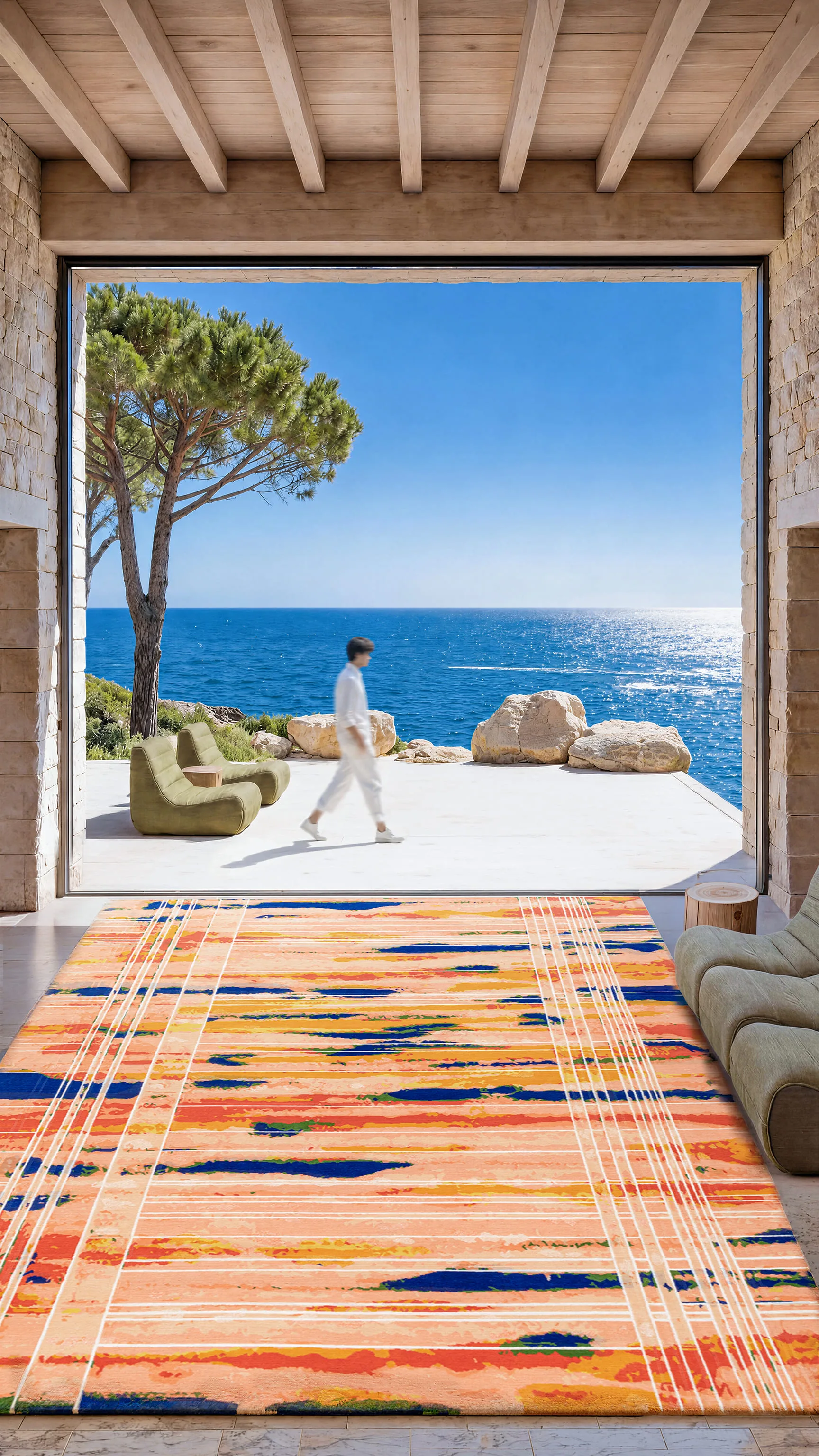
On the rue du Bac, the window is blue. It can be recognised from the opposite pavement, and even through the window of a passing taxi. This blue is the colour of Diacasan Edition. It comes from no artist, no collection, no commission: it comes from Sandrine, who sums it up thus: “Blue is the horizon, it is the sky, it is the sea, it is the ocean.” For anyone looking for a blue rug, this origin matters, because it explains why the colour returns from one collection to the next without ever repeating itself. It takes the form of cobalt with Christian Signorel, of azurite in the new version of MINOTOR, of an arctic blue set against white with Messieurs. Each time, a different wool, technique and design recompose it. The blue of the house can be followed through the pieces like a direction rather than a swatch on a colour chart.
A colour without a legend
Diacasan blue has no founding tale. When the artistic director is asked where it comes from, she replies that there is no story: it is her colour. She loves every colour, green as well, but blue a little more than the others. She placed it on her window without much calculation. The thought of the horizon came afterwards, fairly recently, like an explanation found by looking at what was already there.
This absence of legend is telling. It says that the blue was not invented for a launch, nor borrowed from a work of art. It precedes the collections. It could already be found in the first logo of the house, a rectangle of a paler blue, almost sky, which the publisher placed in the corners of her rugs. Since then, the colour has gained in depth and in surface: the shopfront, the house van, the showroom. Studio Messieurs, which worked on the concept of the shop, speaks of a “blue experience”. The phrase pleases her.
Hence a simple observation: blue has no collection in its name. It is recognised, from one piece to another, like a signature.
What does the horizon change, for a rug?
The horizon gives a direction rather than a motif. No single piece of the house tells the story of Diacasan blue on its own. The colour returns, carried by artists who do not resemble one another, with the way of looking that accompanies it. “I always look far ahead,” the founder adds. In a rug, this translates very concretely: blue often works like a ground bass, a colour that anchors a composition and lets the other shades move around it.
Landscape is the only image the house accepts around this colour. The sky above a coastline, the sea seen from afar, ice under a cold light. Nothing more, and nothing that is not in the original phrase. It is a rule of the house: one does not embroider around a word that was spoken simply.
Where is blue found in the collections?
The most frequent blue is the cobalt of Christian Signorel. In MINOTOR, it does not appear in every colourway, but it returns often, and it has given its name to the round Cobalt pouf as well as to the Mircur Bleu Cobalt mirror, bevelled tinted glass around a domed central mirror. In BESTIAIRE, the same cobalt dresses the octopus that came from Pompeii, on the Poulpo pouf. These pieces are hand-tufted in India for the rugs, and tailored for the seating.
MINOTOR 2.0 has changed its vocabulary. Its colourways are borrowed from stone, from Argile to Calacatta, and blue there takes the name Azurite: an Oblong or Nef shape, a rug in wool and Tencel, a relief that makes the colour play with the light. The same name is found on the Azurite pouf, in quilted leather.
On the hand-knotted side, blue changes texture once again. NEPALESE RUGS gives a version of it in the Santa Fe rug, Cobalt colourway, in Himalayan wool knotted in Nepal. In SPATIAL, Emmanuel Thibault signs Idol, one of whose colourways is a blue in hand-knotted viscose. Jean-Paul Espinosa, finally, renders his Forêt de Cristal motif as a blue floor cushion, in the PAINTINGS collection.
These blues remain distinct. Placed beside a MINOTOR rug, a GRAND NORD cushion shows it at once: it is no longer the same blue. The house knows this and composes with it, rather than seeking a unified shade that would efface the artists.
Blue and white, the pack ice of GRAND NORD
For anyone looking for a blue and white rug, the answer of the house is called GRAND NORD. Studio Messieurs sets arctic blue in dialogue with the white of a generous, tousled wool. The Nanuk, Arctique and Banquise rugs carry the polar bear and its tracks. The Iceberg and Ice Cube armchairs, ottomans and poufs take up the palette in two bouclette fabrics, among them Excentric, flecked with blue.
White, here, counts as much as blue. Without it, the colour would lose its light of ice. It is one of the rare collections in which the blue of the house reads first as a landscape.
Choosing a blue rug for the home
A blue rug is chosen by looking at the room, not only at the colour. In an interior that is already very colourful, Sandrine Demas advises restraint and leaving the rug a supporting role. In a calmer interior, a MINOTOR brings colour and becomes the point around which the rest is organised. The relief of MINOTOR 2.0 or the Himalayan wool of a hand-knotted piece add another element: light. Hand-spun wool catches it differently according to the angle and the hour, so that the same blue does not show itself in the same way in the morning and in the evening.
That is why a blue is best judged in person. At the rue du Bac showroom, whose scenography was rethought by Messieurs, the pieces are shown in niches that return each rug to its own light. It is there that several blues are best compared with one another, under a light that is not that of a screen.
This movement back and forth between a personal colour and very different artists sums up rather well the craft of a rug publisher. On screen, we fix the blue of the house at #001AA0. In the wool, it is recomposed with every dyeing.
Text written by the house of Diacasan Edition from interviews with its founder and from the records of our collections, October 2026.
Questions fréquentes
What is Diacasan blue?
It is the colour of the house, chosen by the woman who founded it and who describes it as the horizon, the sky, the sea and the ocean. It is attached to no particular collection: it can be seen on the rue du Bac window as on the house van, and it returns in many pieces, under different names such as Cobalt or Azurite. On the website, we fix it at #001AA0; in wool, its shade depends on the fibre, the dye and the technique.
Does Diacasan blue come from an artist?
No. The blue belongs to the house and precedes its collections: it already featured, in a paler version, on the first logo we placed in the corners of our rugs. The artists we publish encounter it, each in his own way, Christian Signorel with his cobalt, Messieurs with the arctic blue of GRAND NORD, but none of them created it. It is a personal colour that became the colour of a house, with no legend added.
Which blue rugs can be found in the Diacasan collections?
Cobalt returns often in MINOTOR and in BESTIAIRE, by Christian Signorel, hand-tufted in India. MINOTOR 2.0 includes an Azurite colourway in wool and Tencel. In hand-knotting, the Santa Fe rug from NEPALESE RUGS exists in Cobalt, in Himalayan wool, and the Idol rug from SPATIAL exists in blue. GRAND NORD pairs arctic blue with white. For a precise navy blue, the best course is to compare samples at the showroom.
A blue and white rug: in which collection?
GRAND NORD, signed by studio Messieurs, is the collection in which blue and white answer each other most clearly. Arctic blue is set against a generous, tousled white wool on the Nanuk, Arctique and Banquise rugs. The armchairs and poufs of the collection take up the palette in bouclette fabrics, one of them flecked with blue. The ensemble can be composed around a single rug or an entire living room.
Does the blue of a rug change with the light?
Yes, and it is particularly visible on wool. The hand-spun Himalayan wool used for our rugs knotted in Nepal catches the light differently according to the angle and the hour: the same blue does not show itself in the same way in the morning and in the evening. The relief of MINOTOR 2.0 also plays with the light, which catches its volumes. We recommend seeing the piece at the showroom, and if possible looking at it at several moments of the day.